Lesson 1 | Restatement
Commentary vs. Paraphrase-Style
Much of what we read when we pick up a book about the Bible is written in commentary-style, with an aim to give the sense of Scripture from the perspective of the observer. The paraphrase-style we teach in this course is different. Those writing paraphrases are aiming to see through the eyes of the Biblical author, unpacking the author's thoughts and feelings from his perspective.

Notice the two pictures above. On the left, the viewer observes the ray of light from the side. There is much to learn from this angle: the object upon which it shines, the quality of the air, and the position of the window with reference to the room. Commentary-style captures the essence of a passage in a similar way.
But the person on the right can see from a perspective that the observer on the left cannot—the pathway of the light. In the same way, the paraphrase writer is able to see along the pathway of the author’s train of thought.
A Biblical Warrant for Each
Each of the above writing styles are abundantly represented in the Bible. Consider the following examples:
Biblical Examples of Commentary-Style
The above commentary-style teachings exemplify a technique repeated throughout the New Testament—a passage is quoted, with an explanation coming before or after from a third-person teacher’s perspective.
A Biblical Example of Paraphrase-Style
In the above paraphrase-style teaching, Stephen utilizes various paraphrasing techniques to tell the story of Abraham from the inside.
- In v. 3, instead of quoting Genesis 12:1 as-is and then commenting on the significance of sending Abraham to a new place, Stephen simply paraphrases the passage, making slight adjustments in the second half of the quotation by removing the phrase “from your father’s house” and adding the word “go.” This succinctly emphasizes the part Stephen wants to point out.
- In v. 4–5, he uses a summary (something you will also learn how to do in this course), in order to communicate the main points of Genesis 12–15. Though he is not speaking in first-person, he is still paraphrasing the author of Genesis since Moses also narrated Genesis in the third person.
- In v. 6–7, he loosely paraphrases Genesis 15:13–14, beginning in v. 6 from the narrator’s perspective, then adopts a first-person perspective in v. 7, finishing with a broad summary statement of God’s plan (“and worship me in this place”) drawn from later in the Bible (Ex 3:12).
Stephen weaves between different forms of paraphrasing, summarizing, and direct citations to reveal to the Sanhedrin the dark role they were playing in God’s story. And what an effect his words had, striking a nerve so violently that they responded in bloodshed!
Advantages of Each
Take a look at the two parallel examples from Psalm 14:4-6. The first, a commentary from Derek Kidner's Classic Commentary Series,¹ and the second, a paraphrase of the same passage.
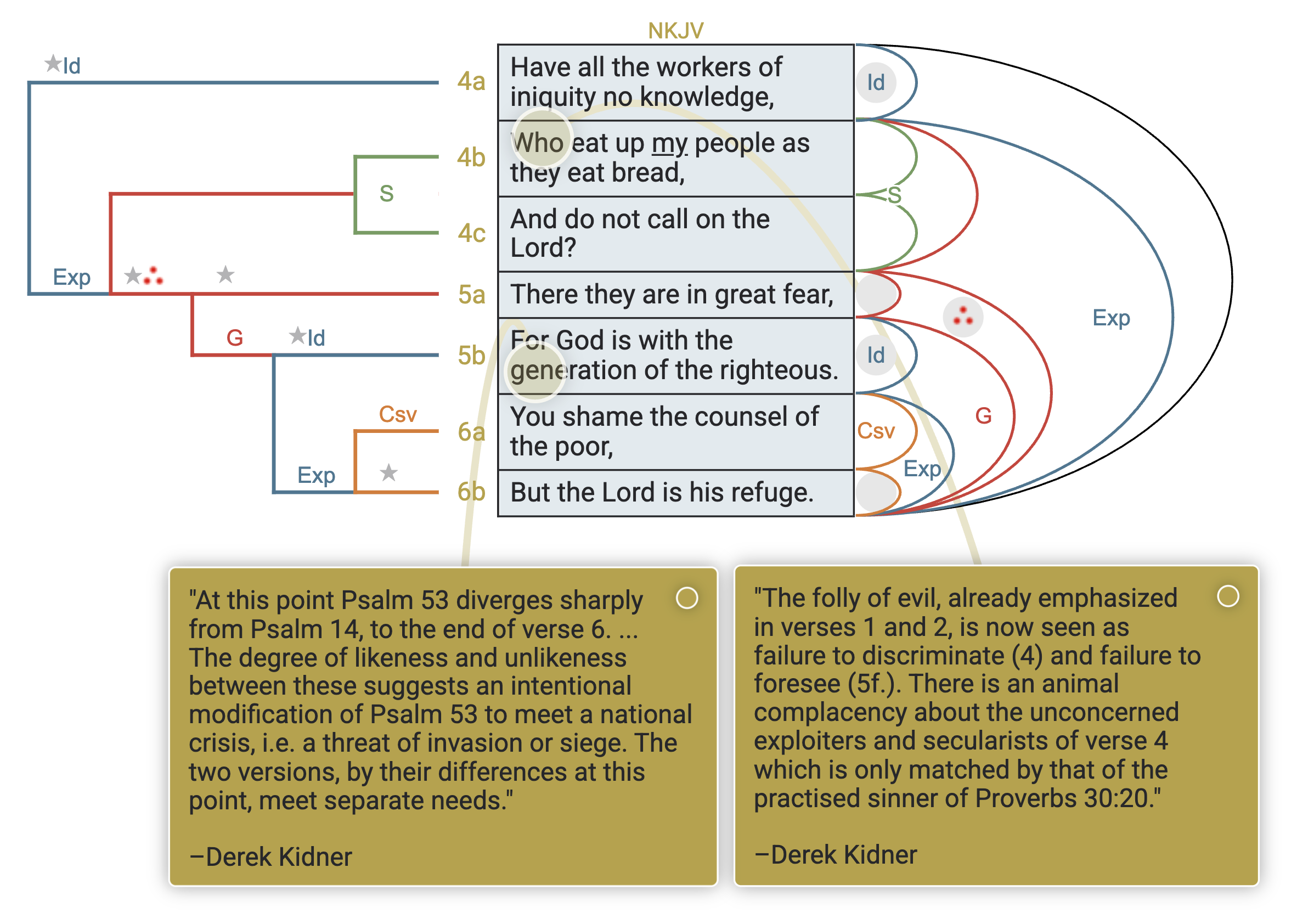
What are the advantages of commentary-style here?
- Kidner is able to highlight the context better than in a paraphrase, noting the connection of vv. 4-5 with vv. 1-2.
- Kidner suggests an explanation regarding a point of uncertainty: the differences and similarities between this psalm and Psalm 53.
- Kidner draws implications from details in the text, focusing in on the animal-like nature of the persecutors in 4b.
- Kidner practices the discipline of theology, something most conducive to commentary-style.
In employing commentary-style, Kidner speaks in the 3rd person perspective, as one approaching the text from the outside. For this reason, we have placed Kidner’s comments in dot notes, not in a MINE column.
Dot notes are ideal for your commentary-style writing because they attach to specific words or phrases and leave the MINE column clear for your paraphrase.
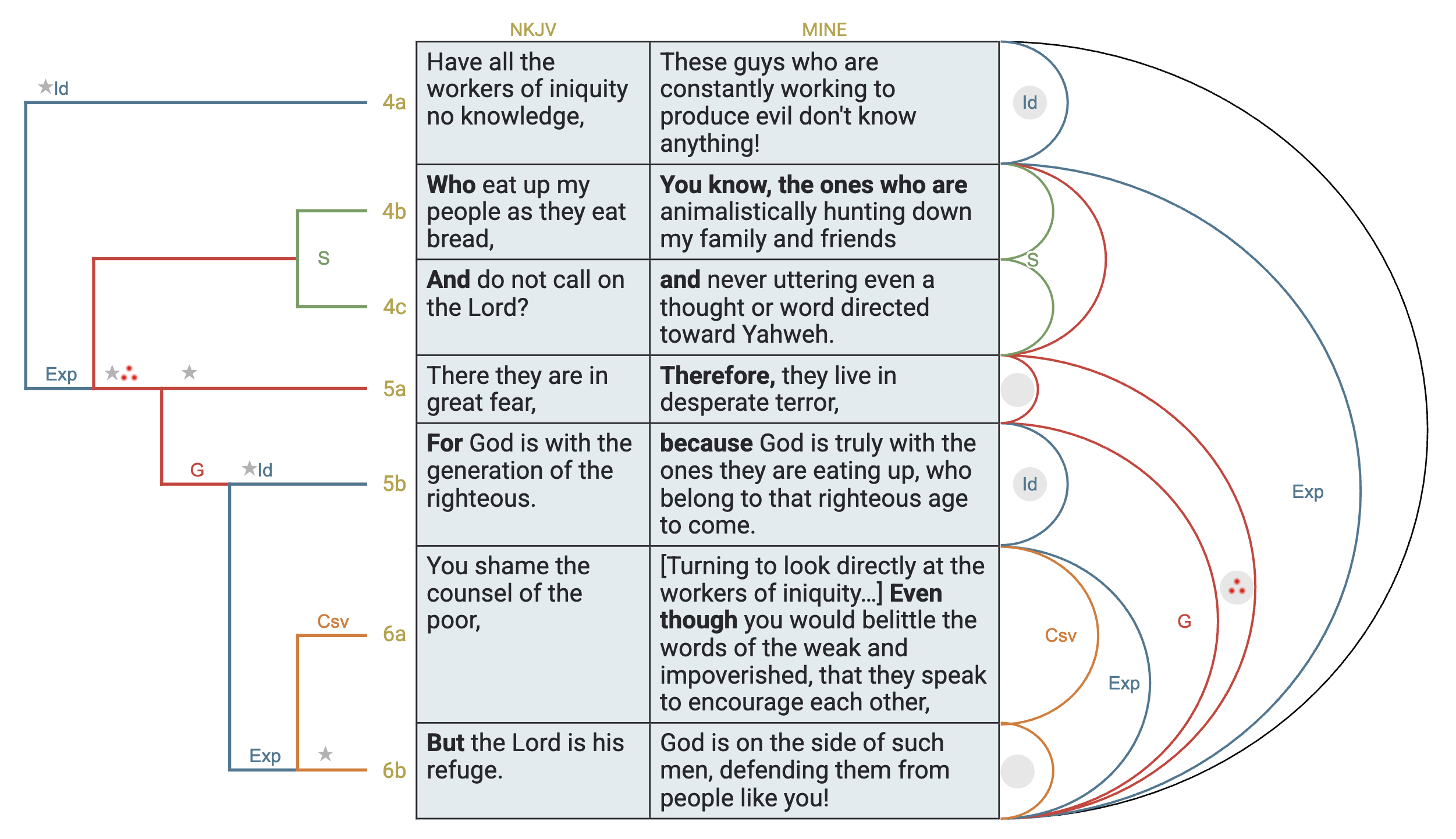
What are the advantages of paraphrase-style here?
- It is more direct, giving the the reader immediate sensory access to what the writer of the paraphrase believes the passage to be saying.
- It is more succinct, communicating in brief statements the interpretational sense of each proposition.
- It enables the tone to be heard, which in this passage is that of hard-hitting reality and direct rebuke.
- It is most conducive for expressing the logical flow of text, proposition by proposition.
- It follows the perspective of the author, not talking about the text, but talking out the text.
Using paraphrase-style, notice that we have placed all of our paraphrasing in the MINE column.
The MINE column is the ideal place for your paraphrase, lining your interpretation up with the passage proposition by proposition.
Assignment (Part 1)
To solidify this distinction, write a brief (1–3 sentences) commentary and paraphrase in the boxes below for 2 Corinthians 5:21.
Commentary
Log in / create an account to enroll or continue where you left off.
Paraphrase
Log in / create an account to enroll or continue where you left off.