Lesson 1 | Restatement
Stumped: Perspective Failure
A detective who can’t put himself into the shoes of the suspect is suffering from perspective failure, the inability to reconstruct the evidence from the suspect’s point of view. “The pieces don’t fit!” he says, because he’s looking at the details from the outside. He needs to put himself into first-person perspective to get into the head of the suspect and follow the evidence to determine the truth.

A real-life, book-writing thief makes this point well:
I eventually came to realize that when a detective or security expert used a flattering phrase like “superhuman” in connection with one of my scores, what he was really doing was covering up his own failure of imagination. If he couldn’t figure out how I’d pulled off the heist, he retreated behind the excuse that the thief must have been a “human fly” or “the best there ever was.” What other explanation could there possibly be, other than that the detective wasn’t clever enough to figure it out, which is not something a law enforcement professional is anxious to admit.
—Bill Mason, Confessions of a Master Jewel Thief

An Example from Ecclesiastes
Like a detective, the writer of a Bible paraphrase must use his imagination, stepping into the shoes of the author to see things from his perspective. Failure to do so will cause him to reconstruct a scene in way that either leaves him stumped or leads him to an invalid conclusion.
Take a look at the two paraphrases below from Ecclesiastes 3:18–21—the passage we just studied in the previous step. Can you spot the ways that the first paraphrase fails to capture the proper perspective of the biblical author while the second captures it accurately?
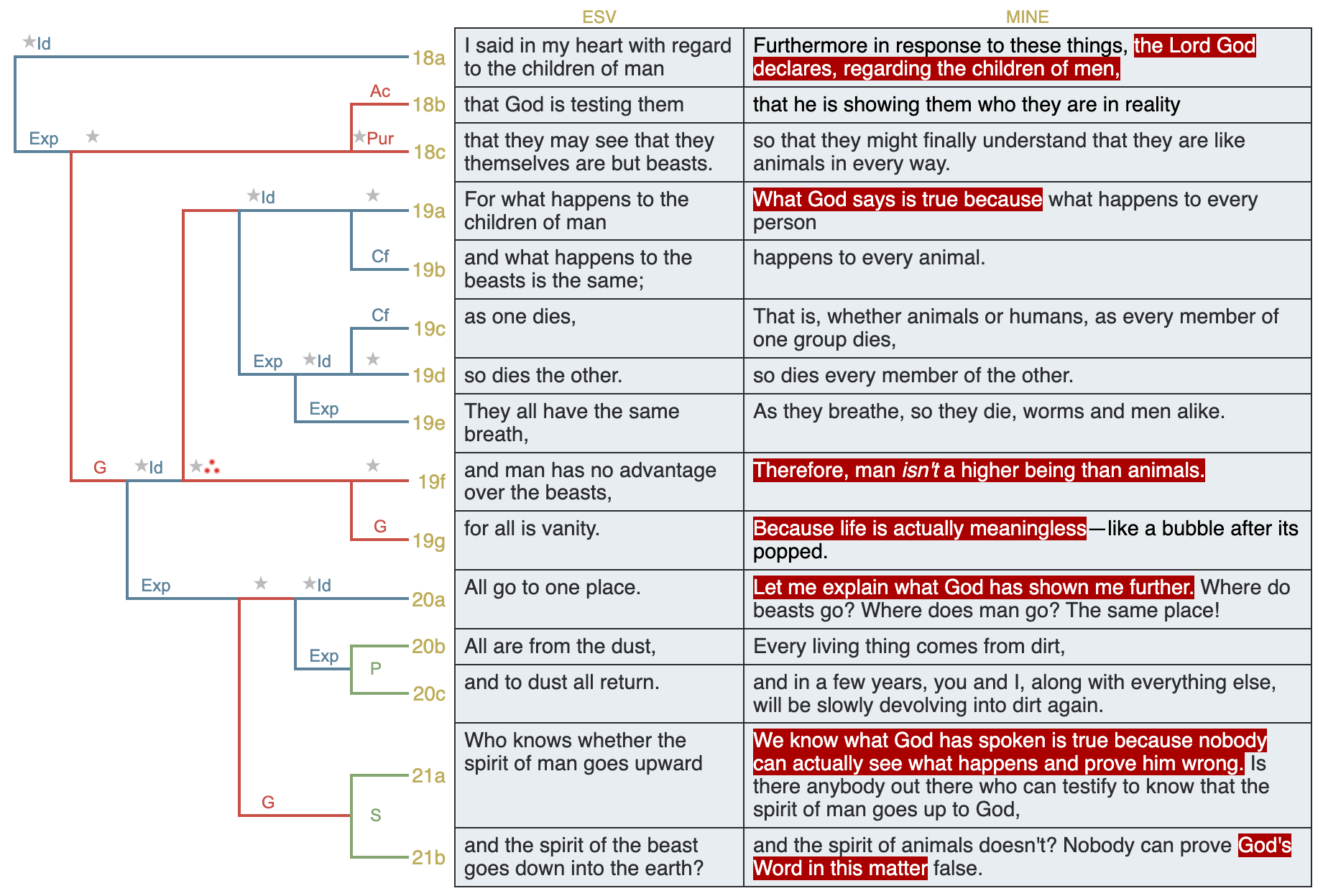
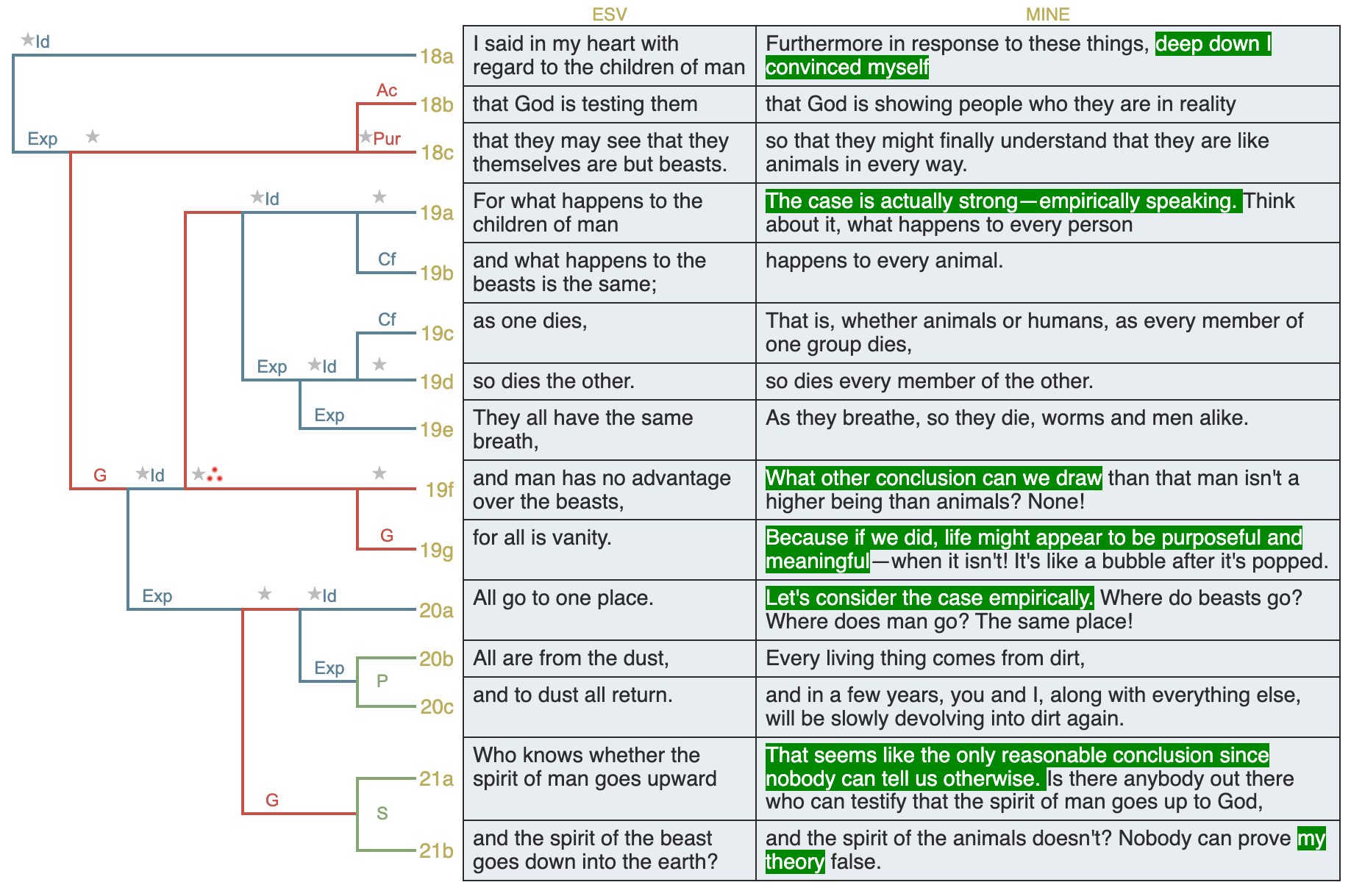
The biblical author of Ecclesiastes is not writing from the perspective of having received a message from the Lord (as the first paraphrase communicates) but from the perspective of a skeptic making observations (as the second paraphrase communicates). Phrases like “I said in my heart” (v. 18), along with skeptical “who knows” questions (v. 21), indicate that the author is writing subjectively. He is looking at life “under the sun” (3:16), that is, only according to what his eyes can observe.
Not taking this into account puts the writer of the first paraphrase in a place of contradicting the rest of Scripture! He communicates at least three falsehoods in his paraphrase:
- That people are the same as animals (contradicting Gen 1:24–27).
- That God tests men simply to show them that they are animals (contradicting Heb 2:6–13).
- That there is no afterlife (contradicting 1Co 15:12–20).
Is the book of Ecclesiastes divine revelation then? Of course! It is revelation of what life would be like if man considered only what he saw and not what he hears from God’s Word. “Ecclesiastes states powerfully and repeatedly that everything is meaningless (“vanity”) without a proper focus on God. The book reveals the necessity of fearing God in a fallen and frequently confusing and frustrating world.”¹