Lesson 6 | Interpretational Stances
Christ as Key in your Paraphrase
Christ is the key to all of Scripture, and therefore we have ample Scriptural permission to be looking for him in every passage.

However, before we hastily rush to include Jesus in every paraphrase, we need to carefully consider several important points.
- Every text is written by an author with a specific historical frame of reference. In paraphrasing, it is our primary concern to understand the flow of thought of the passage as the author intended it to be understood.
- Though Jesus is the key to all of Scripture, the door is not always the same. In other words, not every passage relates to Jesus in the same way. Biblearc's Interpretation Course gives an excellent analysis on this page concerning the different ways in which Christ unlocks passages of Scripture. If we force a key into a door that it doesn't fit, we will break either key or the lock. Don't force Jesus into a passage in a way that Jesus doesn't fit!
- Though paraphrasing should include theological or Christological implications, that doesn’t mean Christ must be mentioned in every interpretation.
Therefore...
Paraphrasing Principle:
Explicitly mention Christ in you paraphrase, if it is helpful for following the flow of thought, and when Christ is understood to be directly connected to the interpretation of that passage.
For example, do you remember how we paraphrased Isaiah 40:5?
Isaiah 40:5 – “And the glory of the Lord shall be revealed, and all flesh shall see it together, for the mouth of the Lord has spoken.” Paraphrase – And then he will come! He is Yahweh, King Jesus, who will arrive to Israel at the appointed time, walk on that ready road—hearts prepared by repentance. And there, in Jerusalem, he display his majesty, causing a ripple effect of salvation to reverberate throughout history, reaching the whole world until the coming of the kingdom, in which all will know the Lord, from the least, to the greatest. This will be so because Yahweh has declared it to be.
In the last lesson, I concluded that John the Baptist’s ministry should be reflected in the interpretation of this passage. So, after following the logic of John’s ministry of repentance through the paraphrase, I arrived at v. 5 (quoted above). How could I not see Jesus in that line of thought? He is, after all, the full revelation of God’s glory. And if vv. 3-4 really refer to John, then v. 5 must refer to the one John anticipated.
Another Example of Christ in your Paraphrase
Consider this final example from Isaiah 61:1–2a.
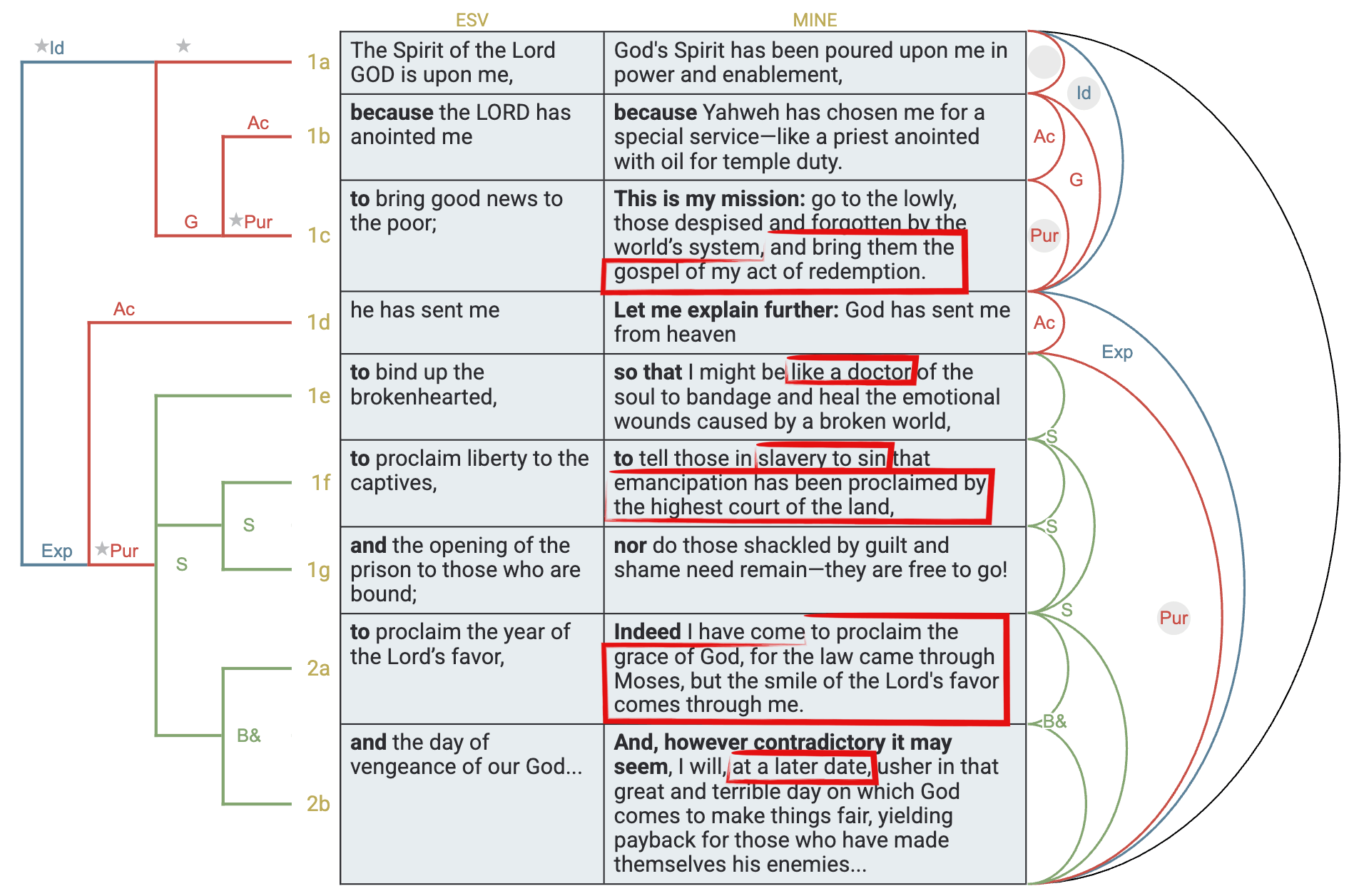
Referring to Isaiah 61:1-2, Jesus explicitly stated, “Today this Scripture has been fulfilled in your hearing” (Lk 4:21). Therefore we have ample permission to weave Jesus' ministry into our paraphrase of this passage.
Including Christ in your paraphrase does not have to happen overtly. Often times, you will do so winsomely, with the natural background of the gospel in mind as you thread New Testament realities into an Old Testament passage. Note the six instances above in which I included subtle nods to a NT redemptive understanding of this passage.
- 1c – The reference to the “gospel of redemption” brings in a fuller picture of the NT gospel.
- 1e – Jesus calling himself a doctor for the sick (Lk 5:31).
- 1f – Draws from John 8:34 where Jesus unpacked the principle of sin-as-slavery for the self-righteous religious leaders.
- 1f – “Emancipation from the highest court” refers to the NT doctrine of justification.
- 2a – Integrates the words of John 1:17 with Jesus' 1st-person perspective.
- 2b – Takes into account that Jesus stopped quoting Isaiah mid-sentence between 2a and 2b when he declared this passage fulfilled. A New Testament perspective can clearly perceive that he was indiciting a distinction between his first and second comings. His first coming was not the time for God’s vengeance (2b), but his second coming will be.