Lesson 7 | Special Cases
Lesson Objectives
Whether it’s a suitcase of single-use gadgets or a compartment in the mind stocked with rare expertise, every detective has a way to crack the most obscure, outside-the-box crimes—the special cases.
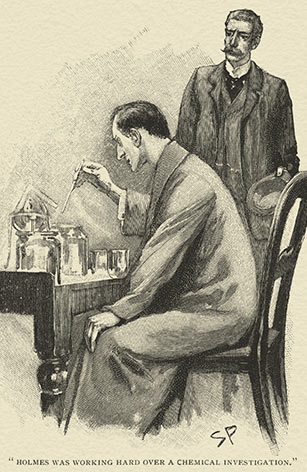
“After walks [he] has shown me splashes upon his trousers, and told me by their color in what part of London he had received them.”
Arthur Conan Doyle, A Study in Scarlet.
As Holmes and Watson’s friendship deepens, Watson is increasingly struck by Holmes’s highly specialized knowledge. Taking stock of his new roommate, he finds a mind unlike that of the average educated Londoner: Holmes knows nothing of literature, philosophy, or astronomy, and only a trace of politics, yet possesses remarkable expertise in chemistry and sensational literature. In his notes on the subject, Watson declared, “He appears to know every detail of every horror done in the century.”¹ Why would a man cultivate such peculiar knowledge? In Conan Doyle’s The Sign of the Four, Watson finally gains insight into Holmes’s specialized toolbox through his explanation of how tobacco aids in solving crime.
Yes, I have been guilty of several monographs. They are all upon technical subjects. Here, for example, is one 'Upon the Distinction between the Ashes of the Various Tobaccoes.' In it I enumerate a hundred and forty forms of cigar-, cigarette-, and pipe-tobacco, with colored plates illustrating the difference in the ash. It is a point which is continually turning up in criminal trials, and which is sometimes of supreme importance as a clue. If you can say definitely, for example, that some murder has been done by a man who was smoking an Indian lunkah, it obviously narrows your field of search. To the trained eye there is as much difference between the black ash of a Trichinopoly and the white fluff of bird's-eye as there is between a cabbage and a potato.
—Arthur Conan Doyle, The Sign of the Four, emphasis added.
Like Holmes, the Bible paraphraser faces special-case passages that force him to draw on his niche technical skills and specialized knowledge. We will deal with three categories of special cases in this lesson—figures of speech, Old Testament quotes, and cultural nuancing.
Specific Goals:
- Explore creative approaches to paraphrasing idioms and figures of speech.
- Learn to unpack the way a NT author is using an OT quote or allusion within your paraphrase.
- Recognize how the target culture ought to shape the way we paraphrase Scripture.
- Avoid the fallacy of imposing modern assumptions on our interpretations.