Lesson 8 | Sub-Point Summaries
Stumped: Red Herring
No matter how good the detective, he must always fight the temptation to be distracted by the details. In other words, he must resist the red herrings.

Red Herring - a clue or piece of information that is, or is intended to be, misleading or distracting.
Oxford Languages Dictionary
In “The Five Red Herrings” by Dorothy Sayers, artist Sandy Campbell winds up dead at the bottom of a jagged seaside cliff. Six suspects quickly emerge, each with sour feelings toward Sandy, and each entangled in the details of the case. The catch? Every one of them has an alibi!
The investigation buzzes with with maps, timetables, and distance calculations, challenging the Lord Peter Wimsey to confront its maddening complexity. At the heart of it all lies one chilling necessity: the murderer must have been able to slip back into ordinary life without a trace of disruption. That sleight of hand leaves Wimsey and Chief Detective McPherson scratching their heads, following one red herring after another.
The Inspector released him and turned to Wimsey. ‘Not Strachan and not Gowan,’ he said. ‘Gowan’s a verra big man.’
’Not the murderer at all, apparently,’ said Wimsey. ‘Another red herring, Inspector.’
’The place is fair lousy wi’ red herrings,‘ mourned Inspector Macpherson.
—Dorothy L. Sayers, The Five Red Herrings (New York: Bourbon Street Books, 2014), Apple Books, emphasis added, https://books.apple.com/us/book/the-five-red-herrings/id893693638.

After endless calculations and a meticulous re-enactment of the day’s events, Lord Peter Wimsey finally zeroes in on the details that matter most—those few threads capable of unraveling the entire mystery.
How to Not Follow a Red Herring While Summarizing
When creating summaries, it is easy for Bible students to be led astray by red herrings. A minor detail may capture our attention, seem more important than it is, and distract us from the primary points of emphasis in a passage.

Here are four pieces of counsel concerning avoiding red herrings:
(1) Don't be afraid to leave entire propositions or pieces out of a summary.
If the grey dot falls on a single proposition, you’re allowed to hone on it even if its support is a mile long. Indeed, to not do so may cause you to be forever lost trying to make connections at the next level—the supporting details leading you to one red herring after another.
(2) Be wary of prepositional phrases.
Prepositional phrases can seem more important than they are. When summarizing, try mentally setting them aside for a moment—you may be surprised how clearly the the main point emerges.
(3) Know that setting aside a detail to focus on the primary point doesn’t alter the Scriptures.
All Scripture is God-breathed and inspired, so it's natural to feel hesitant when setting aside details to highlight a primary proposition. But remember that you are not actually erasing Scripture, only looking for the central clues to its meaning. Supporting points are necessary and rich with theological truth, but they play a supporting role for a reason—to show off the main point!
(4) Follow the logic of the conjunctions as a default, unless there is a clear argument for the contrary.
Sometimes we may feel the impulse to give a statement primary importance, but the language of the text does not allow it. This is a critical juncture in our study. Only override the natural logic of a conjunction if you can articulate a compelling reason for doing so.
A Red Herring in Colossians 3:1-4
The question at hand when approaching Colossians 3:1-4 is “what is the Ground of 1b?” It seems evident that the command to “seek the things that are above” (1b) is primary, and it is represented as such in both of the following brackets. However, in the first bracket, the student followed a red herring in 1c-d, which he interprets to be the main ground of both 1b and 2a. The summaries below follow his logic:
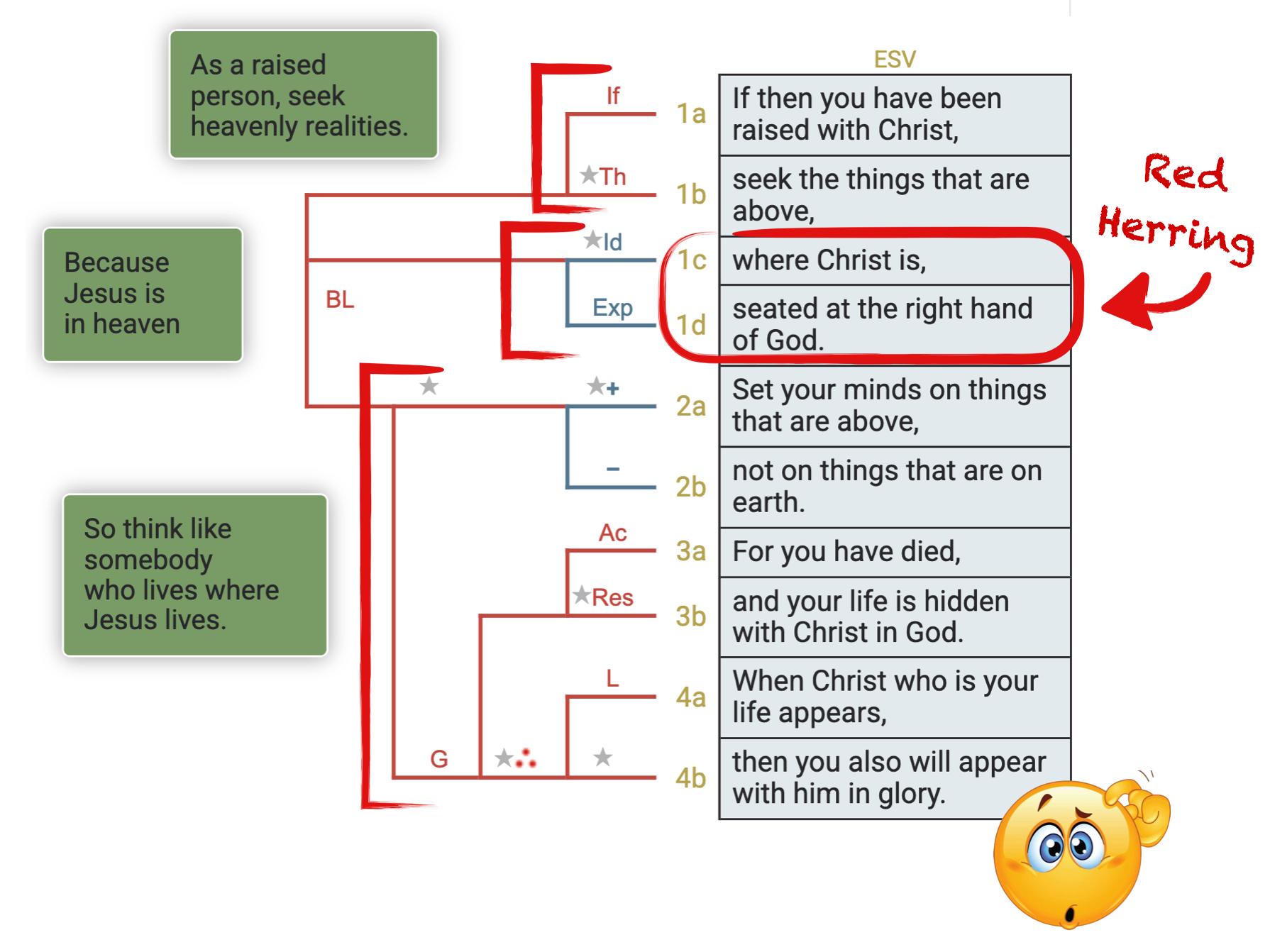
The problem? Christ's location in heaven is not the main reason to seek heavenly realities. The student has chased a red herring—exaggerating the details of 1c-d! Carried to its implications, this logic would suggest that while Jesus was on earth, people ought to have sought earthly realities? By no means!
The key to spotting the red herring is twofold: (1) We must recognize the more prominent grounds in the passage, and (2) Noting 1c-d isn’t even primarily a Ground but a Locative. While it is important to understand that Jesus is in heaven, the main reason we are to seek heavenly things is that we are in union with him. This is the logic of the bottom bracket. In 1a, it states that we are raised with Christ, and in 3a-4b, it makes the point that we have died with Christ, will return with Christ, and will be glorified with Christ. These all speak of our union with Christ and together are the main reason we should seek the things that are above.
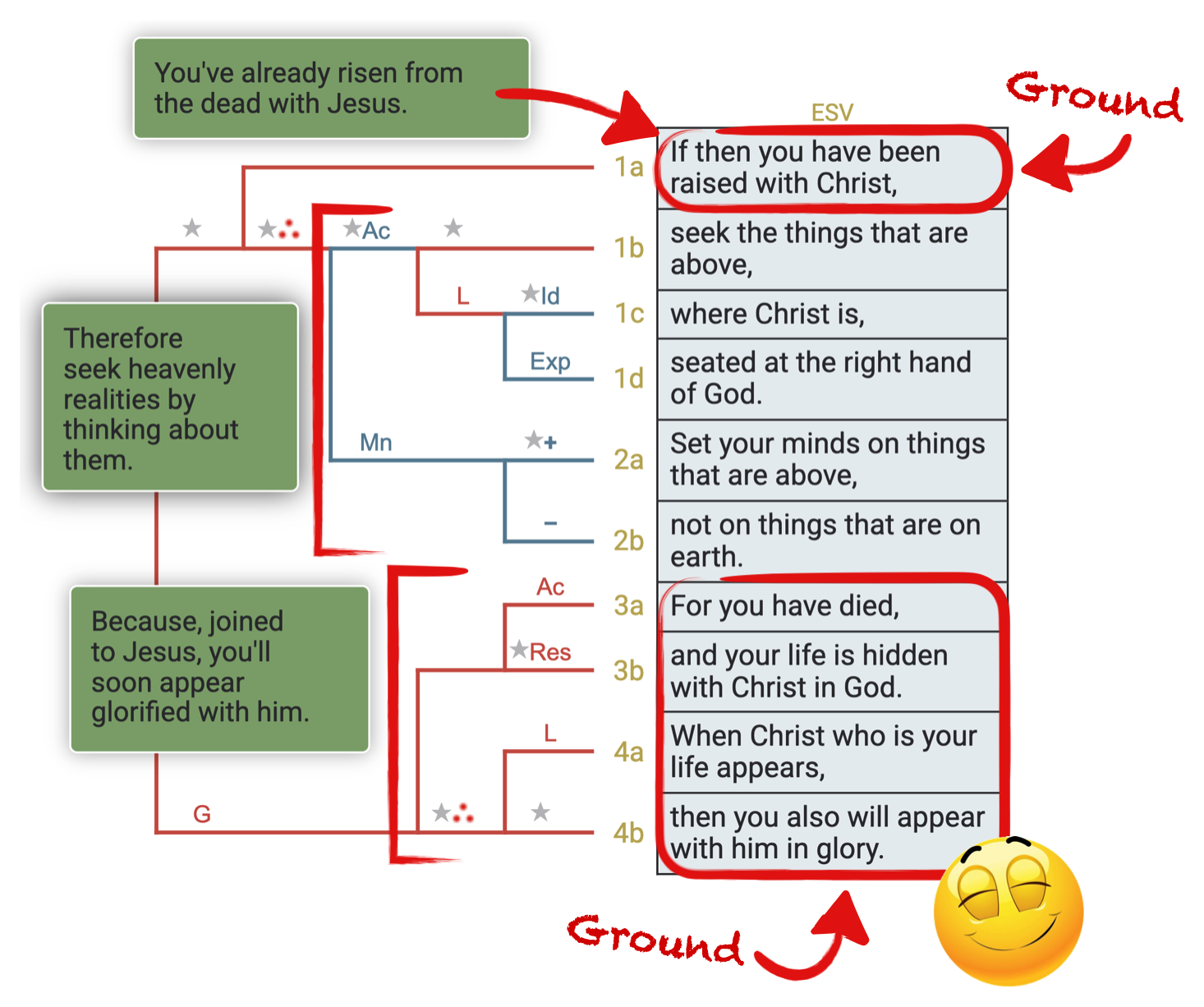
What practical difference does it make?
If Christ's location in heaven is the reason we should seek heavenly realities, it would highlight the distance between us and him. The Christian might be pressured to think in abstract, esoteric, or distant ways—approaches that seem unattainable.
But if seeking heavenly realities is predicated on our union with Christ, those realities are brought within reach. The Christian's motivation flows from participation in Christ’s life, not from his location. This, ultimately, is solid ground for seeking heavenly realities.