Lesson 5 | Test Your Arc/Bracket
Stumped: Cherry-Picking
It is time to address one of the most dangerous investigative fallacies—cherry-picking.
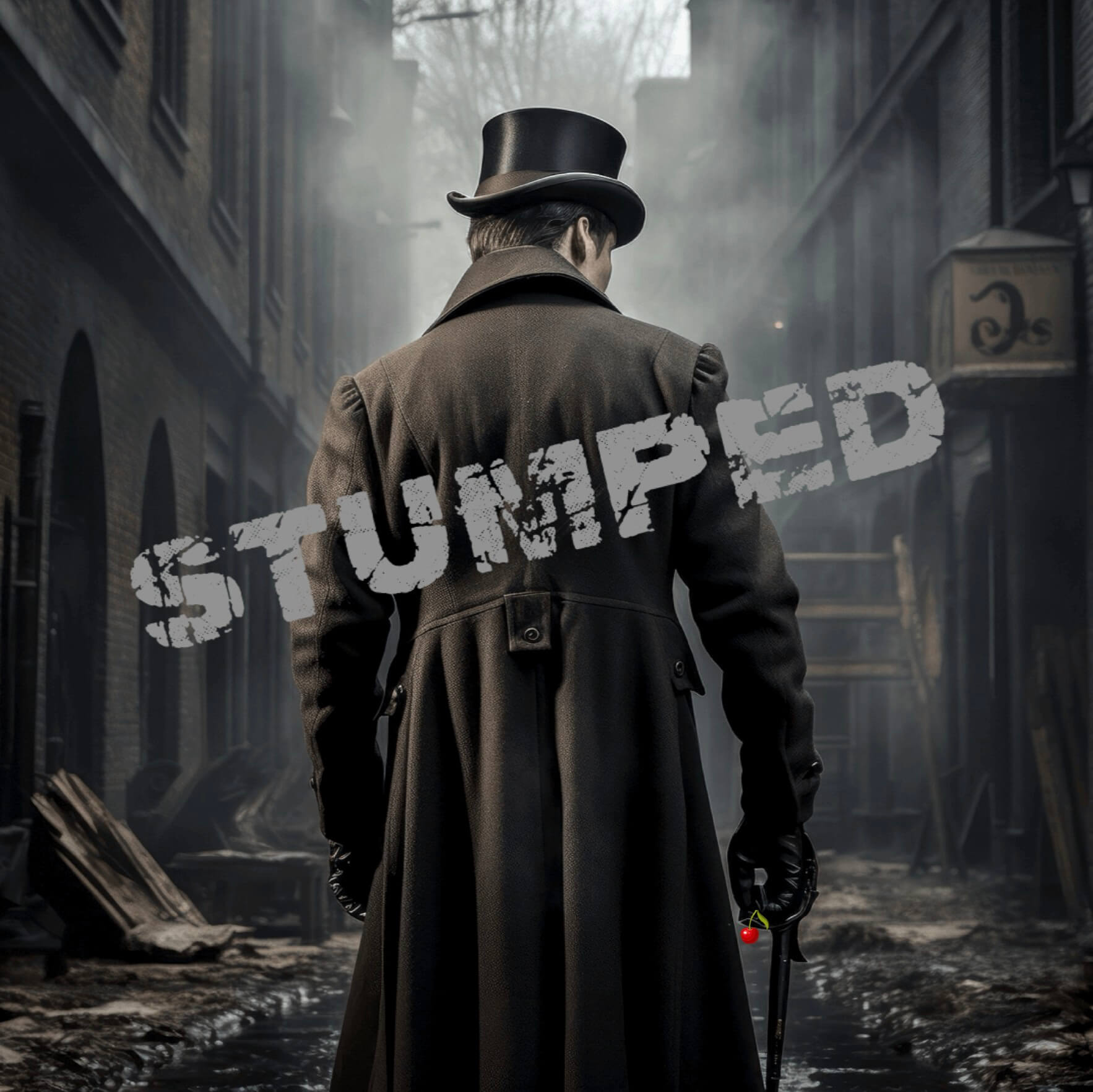
Cherry picking is a logical fallacy where someone focuses only on evidence that supports their stance, while ignoring evidence that contradicts it.
effectivology.com
In the The Adventure of the Beryl Coronet, Sherlock is faced with what seems an open-and-shut case. A banker named Alexander Holder has been entrusted to assure the safety of one of the royal crowns (“coronet”) of England. Having locked it away in his safe, he lies down to restless sleep, only to be awakened by a sound in the night. Rising to inquire, he catches his son Arthur—a man known for his gambling debts—with the crown in hand! Flushed with anger, he accuses his son of thievery and retrieves the crown, only to find three of its gems missing. Arthur, angered at his father’s accusation, declares his own innocence, and refuses to reveal the whereabouts of the gems. Perplexed, Mr. Holder runs to Sherlock for help.
The conclusion seems obvious to Mr. Holder and the police. What else could have happened but that Arthur attempted to steal the crown to pay off his debts? Yet with a few questions, Holmes begins to uncover the logical cherry-picking that Mr. Holder has been partaking in.
‘You have neither of you any doubt as to your son’s guilt?’
‘How can we have when I saw him with my own eyes with the coronet in his hands.’
‘I hardly consider that a conclusive proof. Was the remainder of the coronet at all injured?’
‘Yes, it was twisted.’
‘Do you not think, then, that he might have been trying to straighten it?’
‘God bless you! You are doing what you can for him and for me. But it is too heavy a task. What was he doing there at all? If his purpose were innocent, why did he not say so?’
‘Precisely. And if it were guilty, why did he not invent a lie? His silence appears to me to cut both ways. There are several singular points about the case. What did the police think of the noise which awoke you from your sleep?’
‘They considered that it might be caused by Arthur’s closing his bedroom door.’
‘A likely story! As if a man bent on felony would slam his door so as to wake a household. What did they say, then, of the disappearance of these gems?’
‘They are still sounding the planking and probing the furniture in the hope of finding them.’
‘Have they thought of looking outside the house?’
‘Yes, they have shown extraordinary energy. The whole garden has already been minutely examined.’
‘Now, my dear sir,’ said Holmes, ‘is it not obvious to you now that this matter really strikes very much deeper than either you or the police were at first inclined to think? It appeared to you to be a simple case; to me it seems exceedingly complex. Consider what is involved by your theory. You suppose that your son came down from his bed, went, at great risk, to your dressing-room, opened your bureau, took out your coronet, broke off by main force a small portion of it, went off to some other place, concealed three gems out of the thirty-nine, with such skill that nobody can find them, and then returned with the other thirty-six into the room in which he exposed himself to the greatest danger of being discovered. I ask you now, is such a theory tenable?’
—Arthur Conan Doyle, “The Adventure of the Beryl Coronet,” The Adventures of Sherlock Holmes.
The fact that Arthur was caught with the crown, that the noise in the night was Arthur’s bedroom door, and that Arthur refuses to speak of the matter—these are the cherry-picked evidence. But all it takes is the mention of a few inconsistencies, and Holmes begins to dismantle their theory.
The Bible student is faced with the same temptation to cherry-pick evidence! I have often found myself latching on to one or two details in order to build a theory. It feels so good to have an idea going that I don't want it to be dismantled. So, I find other parts of the text that support my theory, and build an elaborate picture full of connections. Finally, I place the whole package together in a teaching, packed full of illustrations and applications—only to have the whole thing fall to pieces when my negligence is revealed by a simple question regarding a detail I was unwilling to see.
A Cherry-Picked Conclusion from John 2:15–17
By cherry-picking certain pieces of evidence, and ignoring others, it is possible for the irresponsible Bible student to build a case for Jesus being an anti-capitalistic activist in John 2! Take a moment to consider the cherry-picked evidence highlighted in the left column and the skewed scene described in the right.
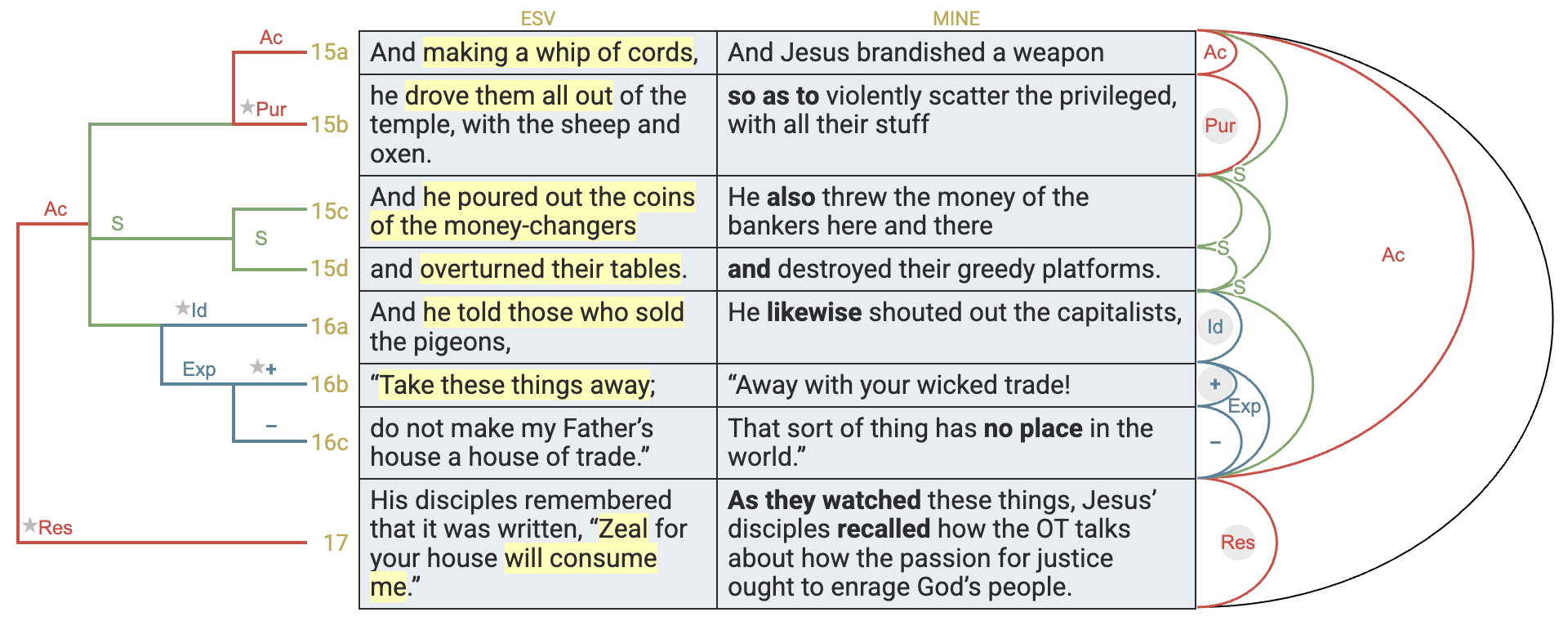
The problem with this interpretation is not found in what is observed, but in what is not observed. Yes, Jesus employs violence in this passage. Yes, this violence was directed toward those doing business. Yes, this violence was driven by zeal.
But now consider which details were ignored: This isn’t trade in general, but the sale of sheep, oxen, and pigeons (sacrificial animals), along with the changing of money. Secondly, this isn’t taking place in a market, but in the temple—the house of Christ’s Father. Such details turn out to be vital and lead us to understand that the issue is not capitalism as a broad economic system, but profiteering within the temple grounds—the one place in the world set apart for worship of the true and living God. In other words, Jesus’ zeal was for worship, not against markets.