Lesson 9 | Combining Summaries
Stumped: The Kitchen Sink Fallacy
When a detective can’t make the evidence add up, it’s tempting to cram every detail into his theory—but doing so commits the kitchen sink fallacy. Bible students can make this same mistake when summarizing. This is critical to avoid so as to not miss out on the third and final purpose of combining summaries: verification of your bracket.

‘You see,’ he explained, ‘A man’s brain is like an empty attic. You have to put in whatever furniture you choose. A fool takes in everything he comes across, so that there is no room for anything useful to find a place, or else the useful information gets so jumbled up with everything else that he has difficulty laying his hands upon it.’
Sherlock Holmes, from Arthur Conan Doyle, “Sherlock Holmes Remastered: A Study in Scarlet.”
In Sherlock Holmes’ first recorded adventure, A Study in Scarlet, Holmes works alongside two detectives from Scotland Yard to solve the case of a murdered man named Enoch Drebber. The striking feature of this case is the sheer number of details: footprints all around the room, a wedding ring lying on the body, several documents in the victim’s pockets pointing to potential suspects, and the word “Rache” scrawled on the far wall. As each detective followed his own lead, Gregson was the first to boast that he had solved the mystery. Summarizing his theory, he claims that the son of the victim’s landlord, Charpentier—whose sister the victim had mistreated earlier that night—followed him and committed the deed. But Gregson’s handling of the evidence reveals a classic kitchen sink fallacy.
[M]y theory is that he followed Drebber as far as the Brixton Road. When there, a fresh altercation arose between them, in the course of which Drebber received a blow from the stick, in the pit of the stomach, perhaps, which killed him without leaving any mark. The night was so wet that no one was about, so Charpentier dragged the body of his victim into the empty house. As to the candle, and the blood, and the writing on the wall, and the ring, they may all be so many tricks to throw the police on to the wrong scent.
—Arthur Conan Doyle, “Sherlock Holmes Remastered: A Study in Scarlet.”
Notice how Gregson’s summary lumps every key detail under the vague label of “tricks to throw the police on to the wrong scent.” Instead of showing how these details meaningfully connect, he throws them all (along with the kitchen sink) into a pile and presumes the case solved.
When summarizing sub-points in the Bible, our goal is likewise to distill the essentials so that the right connections emerge. Yet it can be tempting, when we don’t fully grasp a passage, to throw in details at random, hoping they help. The result is a summary that clouds connections rather than clarifying them.

A Kitchen Sink Fallacy in Galatians 2:6–10
Take a look at the kitchen sink fallacy in action in the sub-point summaries of Galatians 2:6–10 below.
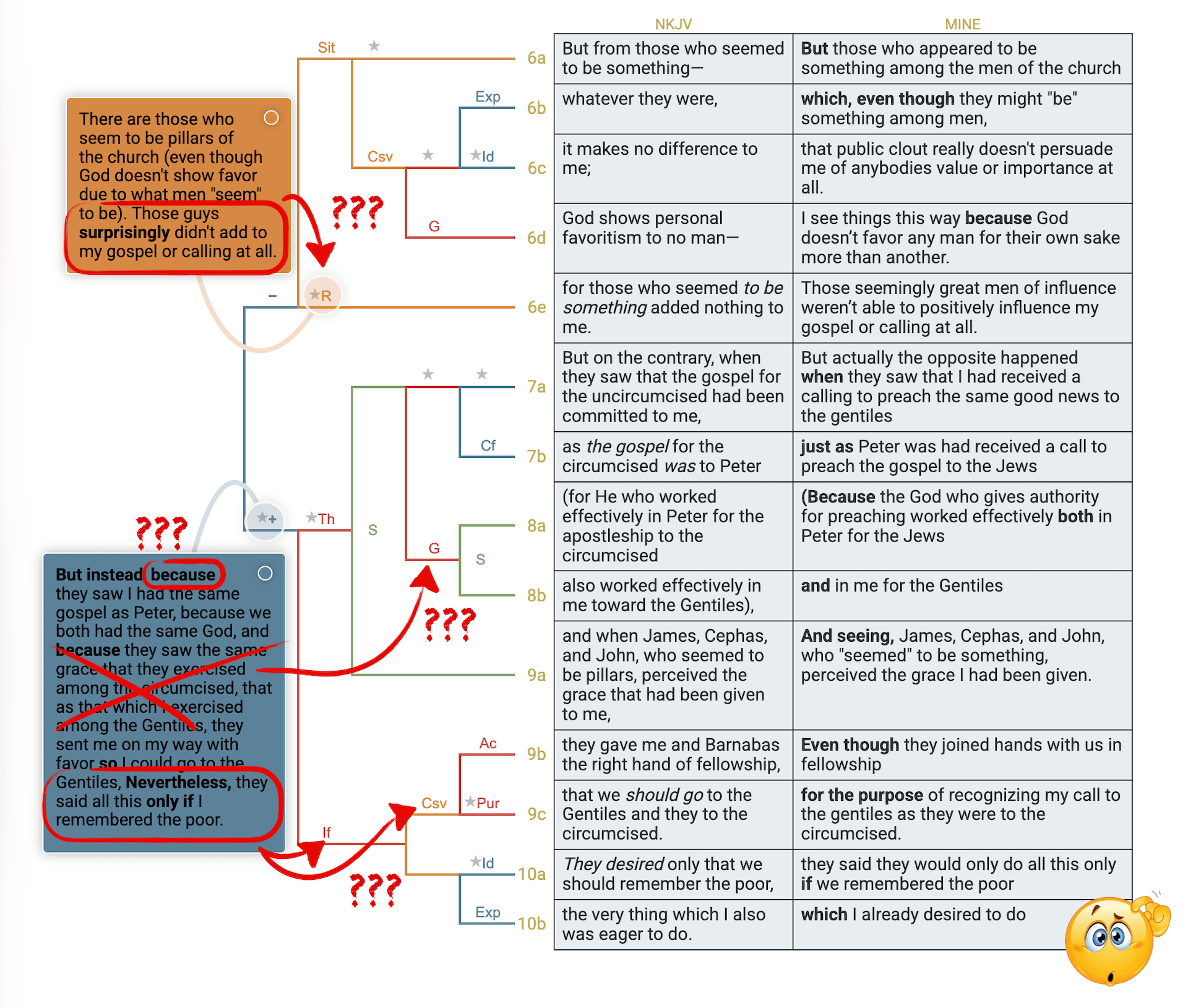
As you can see in the example above, these summaries are way too long. The result is a plethora of confusing inferences that hinder me from making the proper connections.
In the first summary, I take what is ultimately a singular idea in the text (6a and 6e), and change it into two. This causes me to mistakenly think that Situation-Response is the proper relationship between them when there is no situation to respond to!
In the second summary, my kitchen sink fallacy leads me to add in far too many conjunctions and connections. This in turn causes me to miss an important ground relationship in the arc, overly emphasizes the very minor point of 8a-b, and results in a confusing If-Then/Concessive combination at the bottom.
Finally, the entire main point is confused because, though the broadest positive-negative is clearly the correct relationship, it is unclear what part of the bottom piece is contrasting the top piece. These kitchen sink summaries are too long to prove helpful in determining clear relationship connections, let alone in driving toward a main point summary.
As a sidebar, I have a confession to make. Though these summaries and bracket have been adapted slightly for the purposes of this lesson, they are very close to the first project I ever turned in to a Biblearc coach for feedback. You will not be surprised by his (slightly paraphrased) feedback: “There are too many details in your summaries!”
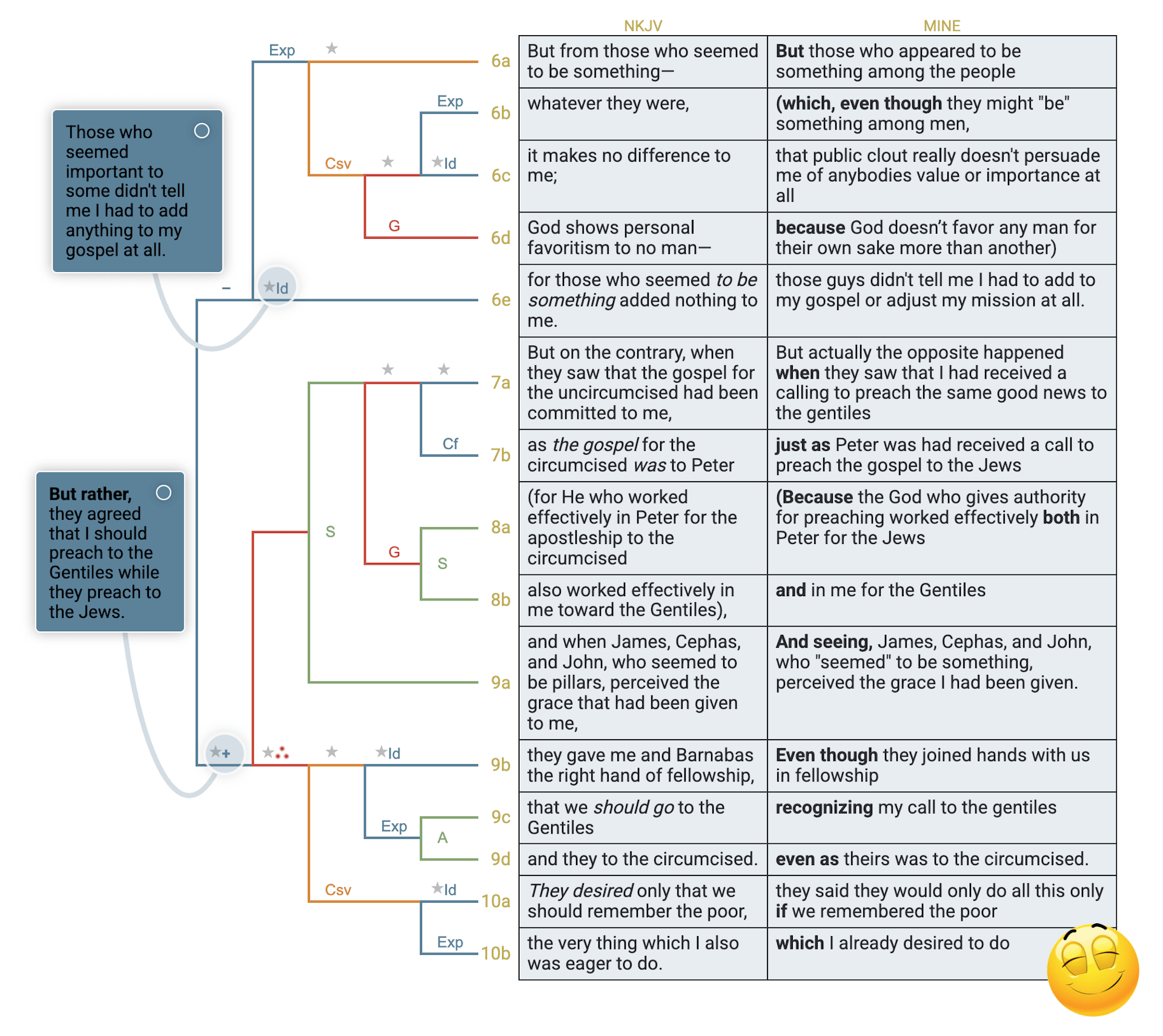
Now let's take a look at a corrected version of Galatians 2:6-10.