Lesson 5 | Test Your Arc/Bracket
#2 | Check for Continuity
The second verification marker is achieved when you can read through your paraphrase with satisfaction.

In the last step, we talked about alignment from left-to-right, ensuring that the logic of our paraphrase aligns with the relationship choices and structure of our bracket. With this marker, we will verify our understanding from top-to-bottom. Does your paraphrase make sense when read through from beginning to end? In other words, does the logic of your bracket flow well when using real language and stringing together real sentences?
A detective does the same thing as he reviews his proposed chronology of events. As he verbalizes his account, it becomes clear where there are holes in his theory. The impulse to object with a “But if that is so, then why…?” type of question is irresistible to the careful listener when the theory doesn’t work.
Paraphrasing Principle:
An accurate bracket will demonstrate internal coherence as the paraphrase is read through top-to-bottom.
Investigative Example: Isaiah 40:1–5
As I read my paraphrase aloud, I tripped over 2c–d. Give it a try yourself.
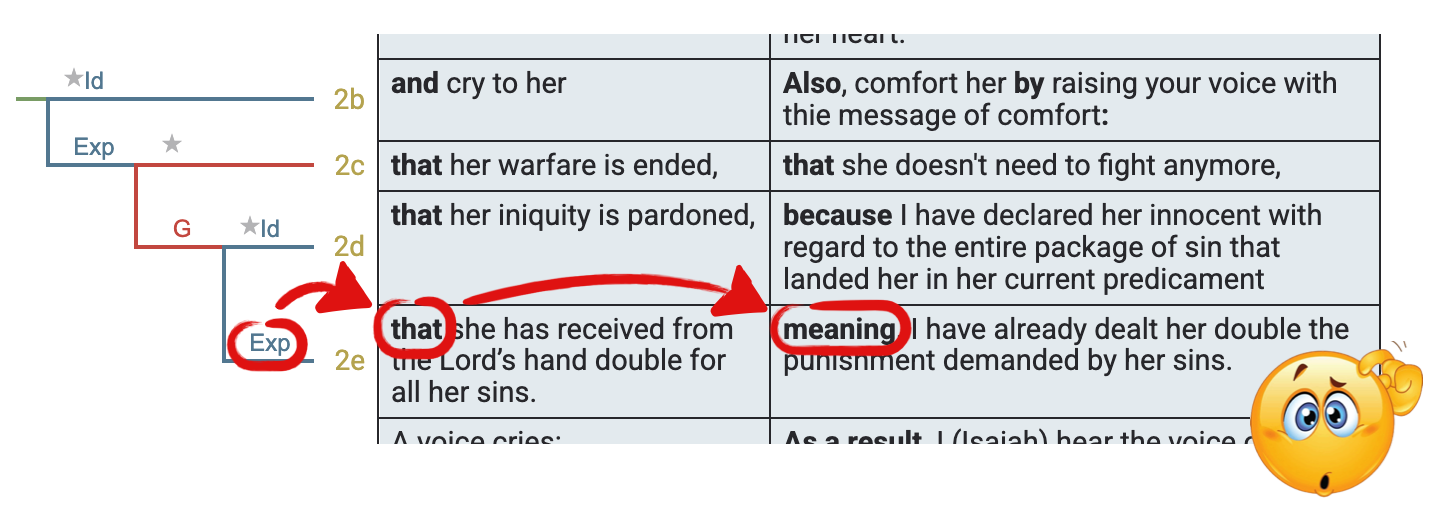
Jerusalem being declared innocent of all her sin is not the same idea as her receiving double punishment for her sin from God. God does not punish innocence! Going back to the drawing board, I thought through 2e’s conjunction afresh. Given that I am interpreting the “that” in 2d to convey a ground, perhaps the “that” in 2e is one as well? I decided to try it out and updated my bracket and paraphrase accordingly.
Do you agree with my updated understanding of 2d–e? Why or why not?Optional
Log in / create an account to enroll or continue where you left off.
Do you see any other portions of the current paraphrase that lack continuity when read through aloud?Optional
Log in / create an account to enroll or continue where you left off.