Lesson 5 | Test Your Arc/Bracket
#3 | Re-Examine the Evidence
The third verification marker is complete after you make a line-by-line comparison of your paraphrase with the biblical text.
To check off this final marker, we must ensure our work aligns right-to-left. Starting from the MINE column this time, we are looking for any spots where our paraphrase no longer matches the conjunctions and grammar of the actual text. The aim is simple: we want to verify that our updated understanding lines up well with the inspired biblical text.

Use strategies like these as you check your work right-to-left:
- For each proposition, read your paraphrase and then review the explicit conjunctions in the biblical text.
- Do the same, noting grammar (participles, commands, etc.). Look for anything that doesn’t match.
- Go back to the dot notes you made while constructing your bracket to ensure your paraphrase also reflects a good consideration of those observations and questions.
- Read your paraphrase of a verse and then read that same verse in three different Bible versions. This may expose a misunderstanding you had after just reading your translation of choice.
- Move from your paraphrase to Biblearc’s original language tools, if you know how to use them. (If not, here is a great course you might consider after this one.)
Investigative Example: Isaiah 40:1–5
Comparing my paraphrase of 2c–e with the biblical text, I was once again discontent.
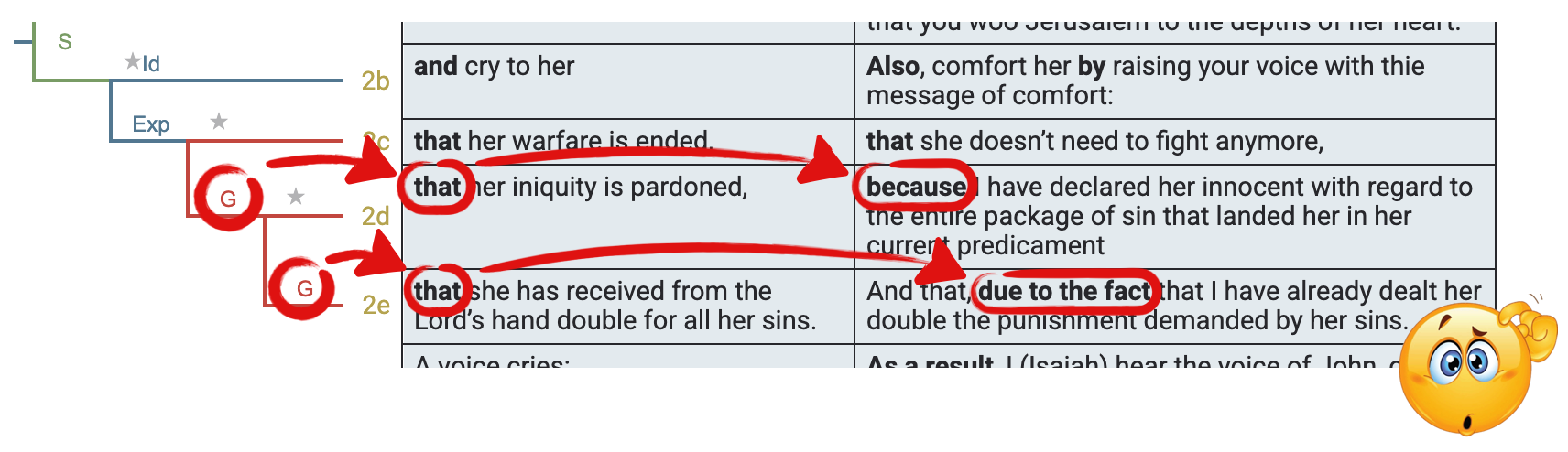
If God truly wanted to convey a pair of grounds here, he probably would have said things differently. Instead, we find three simple “that”s, each of which appears (upon further reflection) to connect independently to the phrase “cry to her.” That would suggest these are three distinct messages of good comfort to Jerusalem. This understanding makes more sense than the unbiblical notion of grounding Jerusalem’s pardon in her double punishment—a concern I raised in one of my initial dot notes. Take a look at how I changed the bracket and paraphrase in light of this reconsideration.
Look at one more instance above where I re-examined the evidence of the actual text. After getting some help with the Hebrew behind the command “Comfort…”, I realized that vv. 1–2 are addressing the people themselves, not just the ‘voice.’ You will hear more about this in the next step, but for now simply note how it led me to rework my paraphrase of 1a.