Lesson 6 | Interpretational Stances
Stumped: Equivocation
What we say with clarity honors the truth—but the cowardly use of double meanings invites distortion, doubt, and even heresy.
Equivocation
The use of ambiguous language to conceal the truth or to avoid committing oneself.
Oxford Languages Dictionary
In Agatha Christie's Peril at End House, Nick Buckley (a young woman) deliberately uses equivocation in an attempt to illegally inherit the fortune that belonged to her cousin Maggie Buckley. Maggie was the heir of her recently deceased (and very wealthy) fiancé, Michael Steton, who had put her full name—Magdala Buckley—on the will. Nick saw the possibility of taking advantage of the situation since her real name was also Magdala Buckley—“Nick” was only a nickname. Intent on convincing the world that she was the real Magdala Buckley, heir to the fortune, she had Maggie murdered and set up several forged romance letters to her “fiancé.” Detective Poirot had his hands full until he realized the truth of the equivocation in names.
‘And then I thought of something else—a few foolish remarks that Hastings had made not five minutes before. He had said that there were plenty of abbreviations for Margaret—Maggie, Margot, etc. And it suddenly occurred to me to wonder what was Mademoiselle Maggie’s real name? Then, tout d'un coup, it came to me! Supposing her name was Magdala! It was a Buckley name. Mademoiselle Nick had told me so. Two Magdala Buckleys.’
—Agatha Christie, Peril at End House (London and Glasgow: Collins Clear-Type Press, n.d.), 247–48, accessed July 30, 2025, http://archive.org/details/in.ernet.dli.2015.92242, bold emphasis added.
Having started on that line of thought, the pieces began to fall into place, and Poirot was able to catch the evil “Magdala” in her scheming swamp of equivocation.
Removing Equivocation from Our Paraphrasing
For some of us, equivocation is our default mode and it takes a lot of work to get rid of ambiguity in our language. For others of us, it is our hiding space—we figure out how to use words that go either way so that we don’t have to choose a side. But we ought to rather want the truth! Therefore, it is better to stick your neck out by clearly stating a wrong interpretation (and being corrected), than to equivocate so as to hide your misunderstandings.
Consider these three paraphrases, all from Psalm 16:9–10. The two words that are paraphrased differently in each are “flesh” and “corruption.”
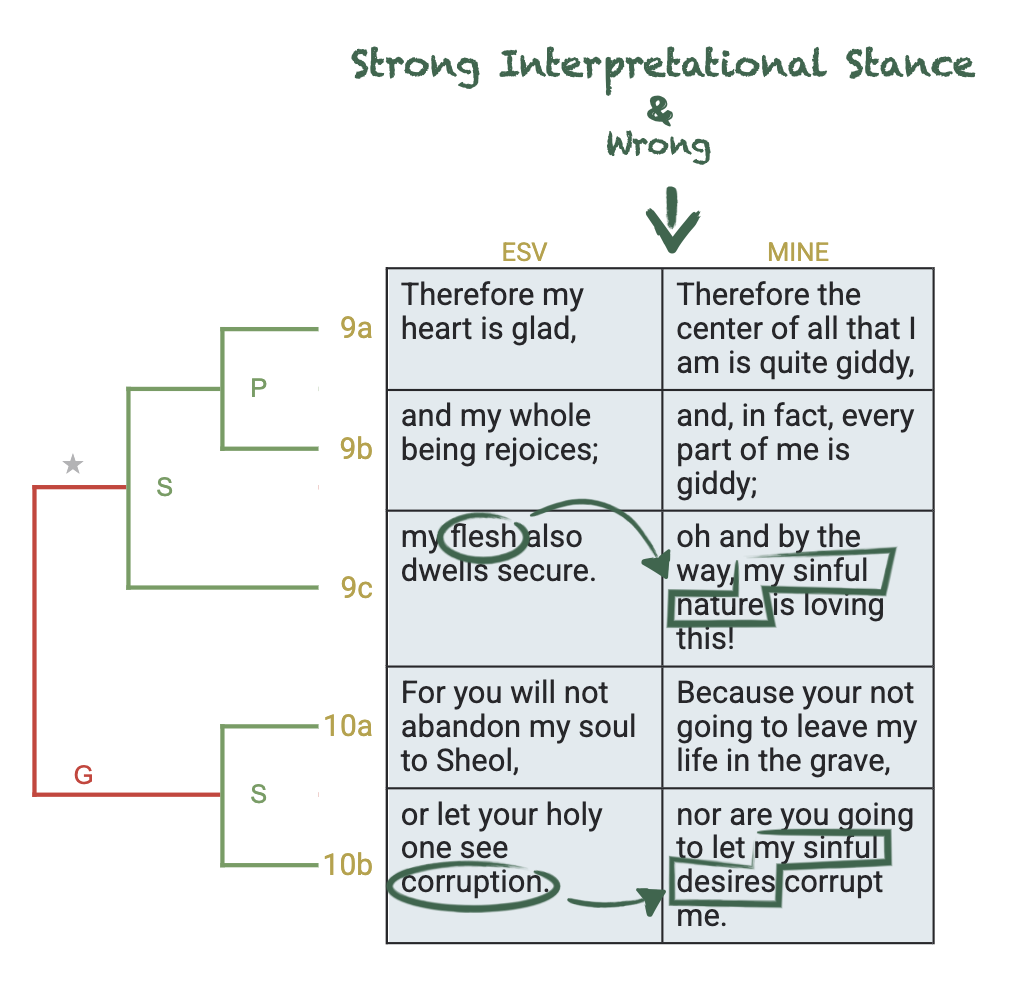
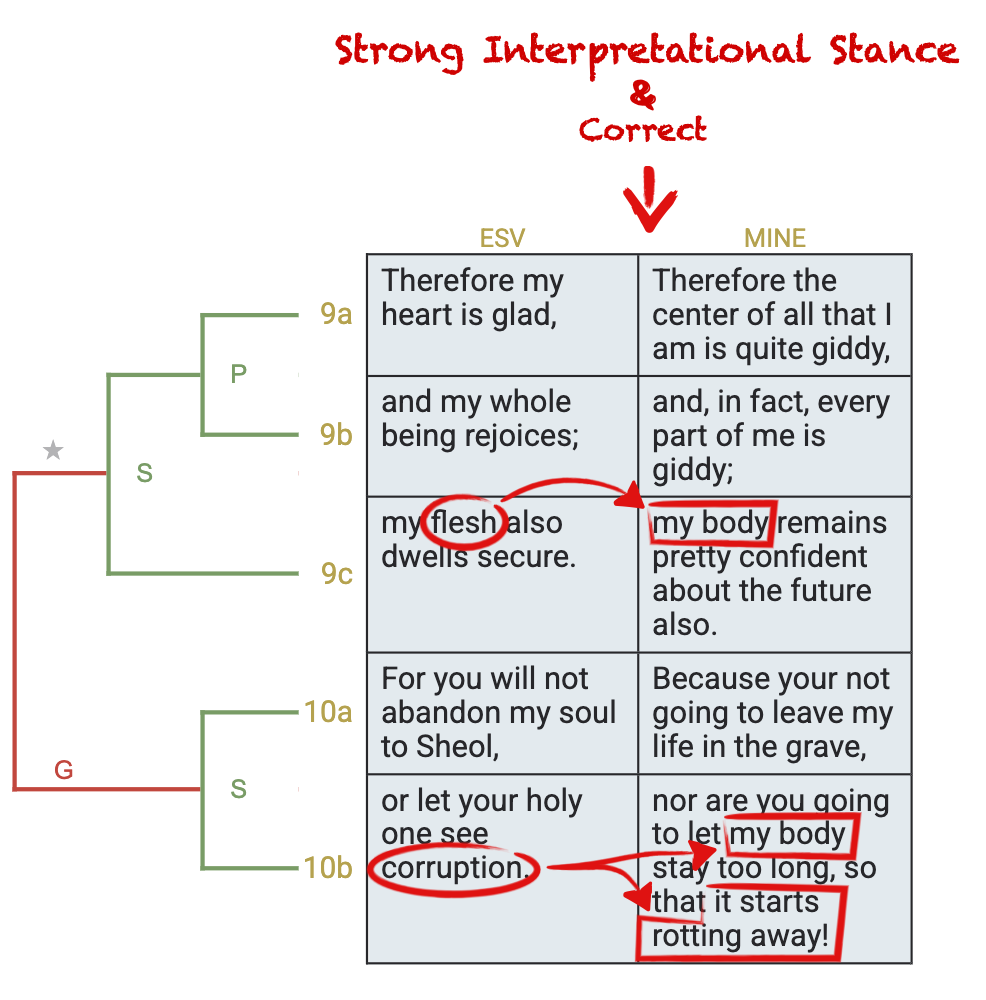
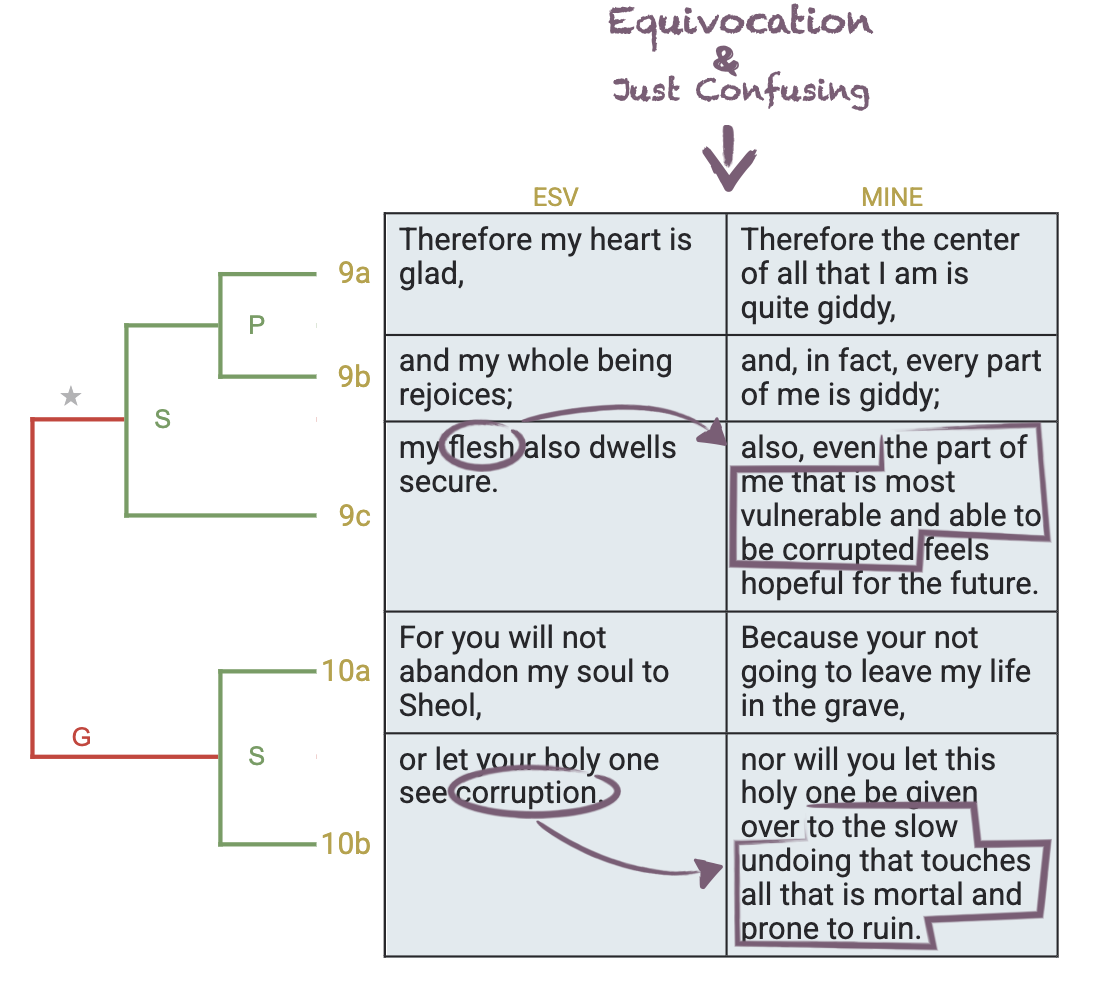
In the first bracket’s paraphrase, the word “flesh” is taken in a NT Pauline sense to mean “sinful nature,” and so “corruption” is interpreted as the corruption that sinful desire brings. That’s a fair try, but not correct. This is made clear by Peter’s inspired interpretation in Acts 2:30–31. But here’s the point: someone will only show you the passage in Acts to correct your misunderstanding after that misunderstanding is made clear.
The final bracket’s paraphrase is not “wrong” per se. Rather, it is so vague that it can’t even be proven right or wrong. Certainly this is far worse than starting from the wrong interpretation!
Less commendable is that form of argumentation that earnestly seeks out the most ambiguous language possible in order to secure the widest possible agreement. Such statements are worthless because they paper over honest differences.
D. A. Carson, Exegetical Fallacies (Grand Rapids: Baker Academic, 1996), http://ebookcentral.proquest.com/lib/dtl/detail.action?docID=4448515.