Lesson 6 | Interpretational Stances
Encouragement & Review
In February of 1836, a United States Representative named Henry Laurens Pinckney introduced a resolution in the U.S. Congress to table any conversation or discussion regarding slavery. The subject had simply become too volatile, and it was perceived as more efficient on the part of the House to avoid it altogether. One of the effects of this unfortunate avoidance was that the right of the people to petition their government was “gagged” as long as the subject of the petition was slavery.
There was one man, however, whose conscience would not allow this false interpretation of the Constitution to stand—John Quincy Adams. Having completed his term as the sixth U.S. president, he had been voted to return to Congress to represent his New England constituency. As a representative, he presented petitions year after year—for eight long years—insisting on reading those that referred to slavery as much as those that didn't. And year after year, the gag-rule was renewed, and John Quincy was voted down, sometimes amid the irate cries and shouts of protest. But his interpretation of the intent of the Constitution came with authority—he was, after all, a senior member of the House, a former president, son of a former president, and had worked in government service under every president since George Washington! If anybody knew the proper interpretation of the right to petition, it was he. This was what he believed:¹
“Petition was prayer...It was the cry of the suffering for relief; of the oppressed for mercy.”
-John Quincy Adams
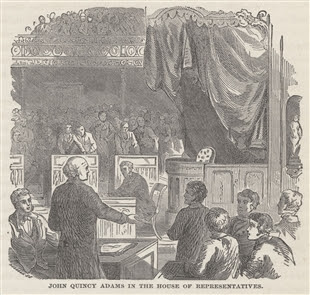
After eight long years and having endured the wrath of many enemies, John Quincy’s interpretational stand succeeded, and the gag rule was abolished. For him, taking an interpretational stand had consequences.
So too for the Bible student. It might prick our conscience and compel us to actions that change the course of our life, inspire others to truth, and draw many enemies. Even so, let us courageously proclaim what we believe God has said in his word.
He said to him, “What is written in the Law? How do you read it?”
Jesus
But before you practice taking an interpretational stand, let’s review.
What we learned this lesson...
- Paraphrasing communicates interpretation intuitively, naturally, and instructively.
- An interpreter takes a humble posture.
- You’ve taken a strong interpretational stance when...
- Your paraphrase clarifies ambiguous language.
- You’ve made a theological position explicit.
- Somebody is able to disagree with you.
- Ask questions to help you deliberate:
- Textual questions
- Contextual questions
- Theological questions
- Genre-based questions
- Mention Christ in your paraphrase...
- If it helps follow the flow of thought.
- When Christ is directly connected to the passage.
- Don't get stumped!... by equivocating on the meaning of Scripture.