Lesson 8 | Sub-Point Summaries
Well-Crafted Contraction
Now that you understand the grey dot, let’s talk about writing sub-point summaries. A sub-point summary is a summary of 2–8 propositions that closely fit together. In later lessons, we will combine larger blocks, but presently the aim is to master things at this fundamental level.

How to Write a Sub-Point Summary
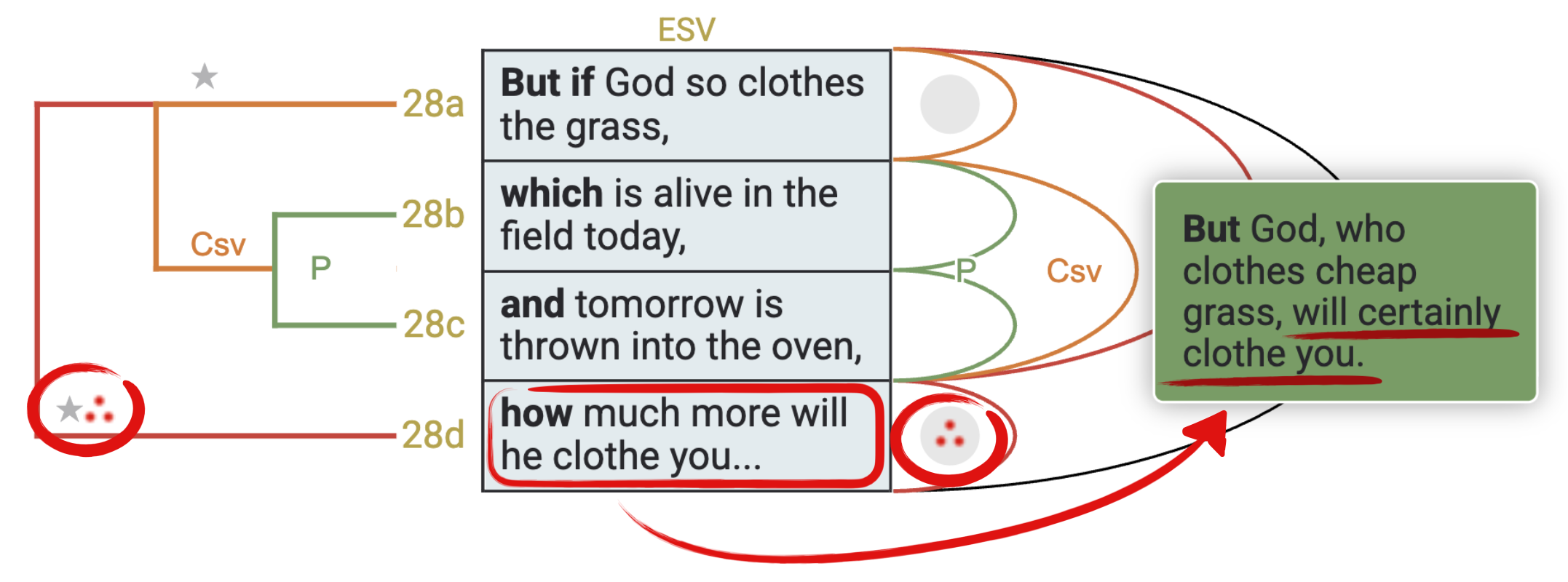
Consider this example from Luke 12:28 as you read through the seven tips below.
1) Choose the correct leading conjunction.
Though the primary proposition might be found at the beginning, middle, or end, the conjunction in the first proposition most often expresses how the author is connecting that piece to others. In upcoming steps, we will be teaching you to build your arc/bracket by tracing the logic of summaries. Therefore, write your summaries with appropriate transition words so that they flow together.
In the example above, we have preserved the “but” that begins the first proposition.
2) Follow the grey dot.
After the previous step, this might go without saying. But still, one can't emphasize this enough—make sure the grey dot aligns with the primary proposition. If it does not, either move it or rework your arc until it aligns with the primary proposition. Only then can you build your summary around it.
Again, note the example above. Our summary reflects the passage’s primary point as indicated by the grey dot on the arc: “[God] will clothe you.”
3) Sift out the details.
There’s a time for detailed unpacking of a passage (think paraphrasing 😉), and a time to distill it down to its core. When summarizing, avoid adding unnecessary detail. If you can turn a phrase into an adjective—good! If you can take out the adjective altogether—better!
Look up at the example. Most details are distilled out of the summary. The promise—God will clothe you—is emphasized, while the ideas of 28b–c are only represented by the word “cheap.”
4) Include all coordinate propositions.
All primary coordinate propositions should be represented in the summary because the biblical author is making more than one point. Sometimes you may use a single broad term or phrase to do this, while other times you will have to include each coordinate idea individually.
5) Find the best word.
As you are writing and reflecting on a passage, stop and consider if one word can pack in more meaning than another.
- Pick words that carry proper nuances of emphasis.
- Use words related to those in the passage without directly quoting from it.
- Use wording from your paraphrase.
6) Maintain the same perspective as the author.
In other words, state the primary point the same way the author does.
In the example at the top of the page, the original text is stated as a promise, so it is framed as a promise in the summary. Also, I do not want to merely describe what Jesus says in my summary, referring to Jesus as “he” and his listeners as “they.” Rather, I want to restate the primary point like Jesus does—as a direct promise: “God will clothe you…”
7) Rearrange the pieces.
This is okay—often even desirable. For example: “a therefore b” can easily be reversed to “b because of a.” Or, “if a, then b” may helpfully be restated as “b, if a.” The goal is to find an arrangement that aids in both clarity and brevity.
Pulling in Supporting Ideas
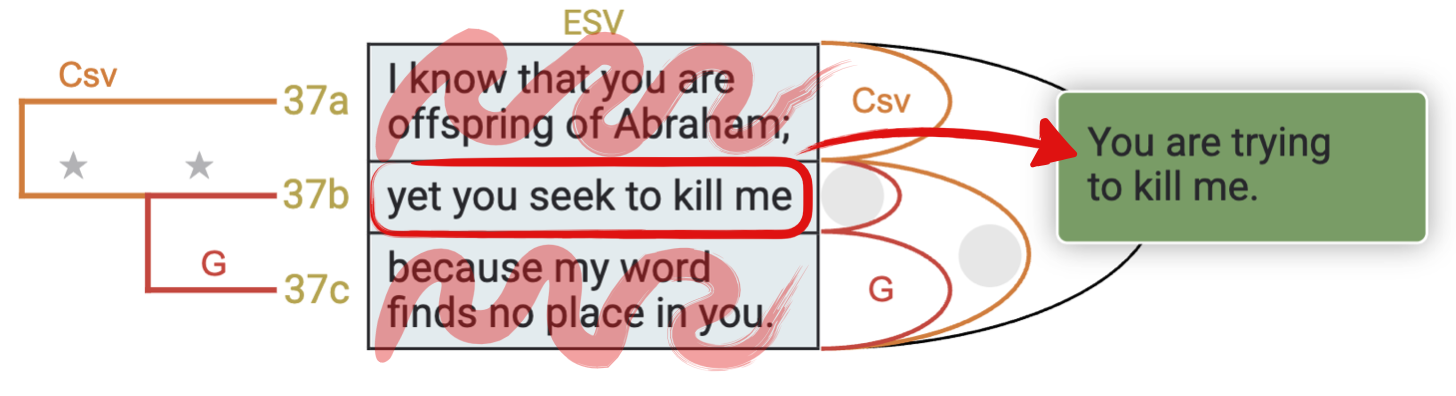
Most of the time, supporting propositions do not need to be brought into the sub-point summary. All that is needed is a brief encapsulation of the primary proposition. Such is the case in John 8:37, in which Jesus forcefully reveals the intentions behind the religious leaders’ murderous desires. Notice here that 37a and 37c are mentally set aside for a moment to encapsulate 37b in the summary.
However, there are exceptions in which a supporting statement is necessary for the summary to make sense. To test whether you are dealing with a case such as this, do a mental experiment. Leave out the supporting proposition and read the primary one on its own. Is the resulting statement nonsensical? Or does doing so alter the meaning, shift the logic, or obscure the text in some way? If so, the supporting proposition must be brought into the summary.
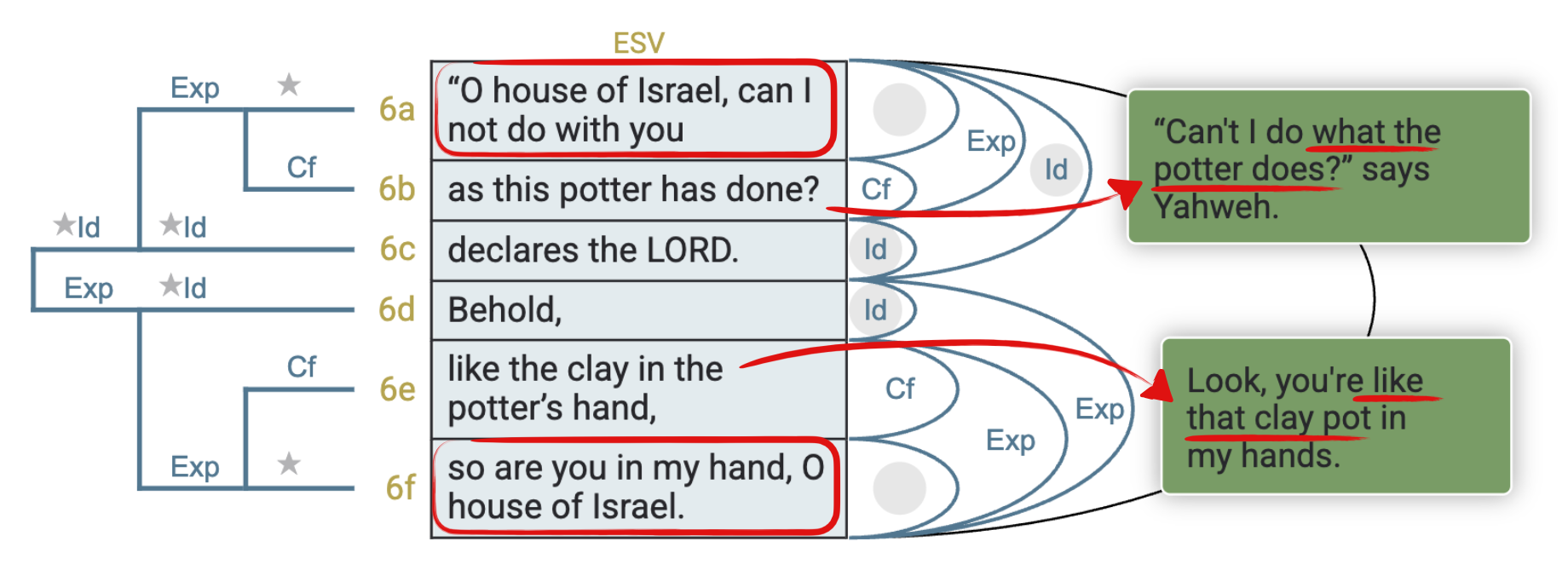
Consider the example of Jeremiah 18:6 in which the Lord uses a masterful illustration to persuade Israel of his sovereign concern for them. Notice that the primary propositions of both Comparison relationships (6a-b and 6e-f) don't make sense unless you include the sense of the supporting Cf statements. If I left out the 6b and 6e, I would have “Can't I do with you?” in 6a and ” You're like [something] in my hand,“ in 6f. Thus, it is necessary to include the supports in the summary.
Now there are many ways to incorporate supports into a summary. I have listed a few below, arranged from most succinct to most explicit:
- Subtly add an adjective, adverb, or other descriptive word into the summary that captures the sense of the support.
- Weave a relative clause or participle clause into the sentence.
- Add a second subordinate proposition to your sentence that captures the sense of the subordinate proposition.
- Add an entire extra sentence communicating the subordinate idea. This option should only be used if absolutely necessary.
Summarizing Our Homework
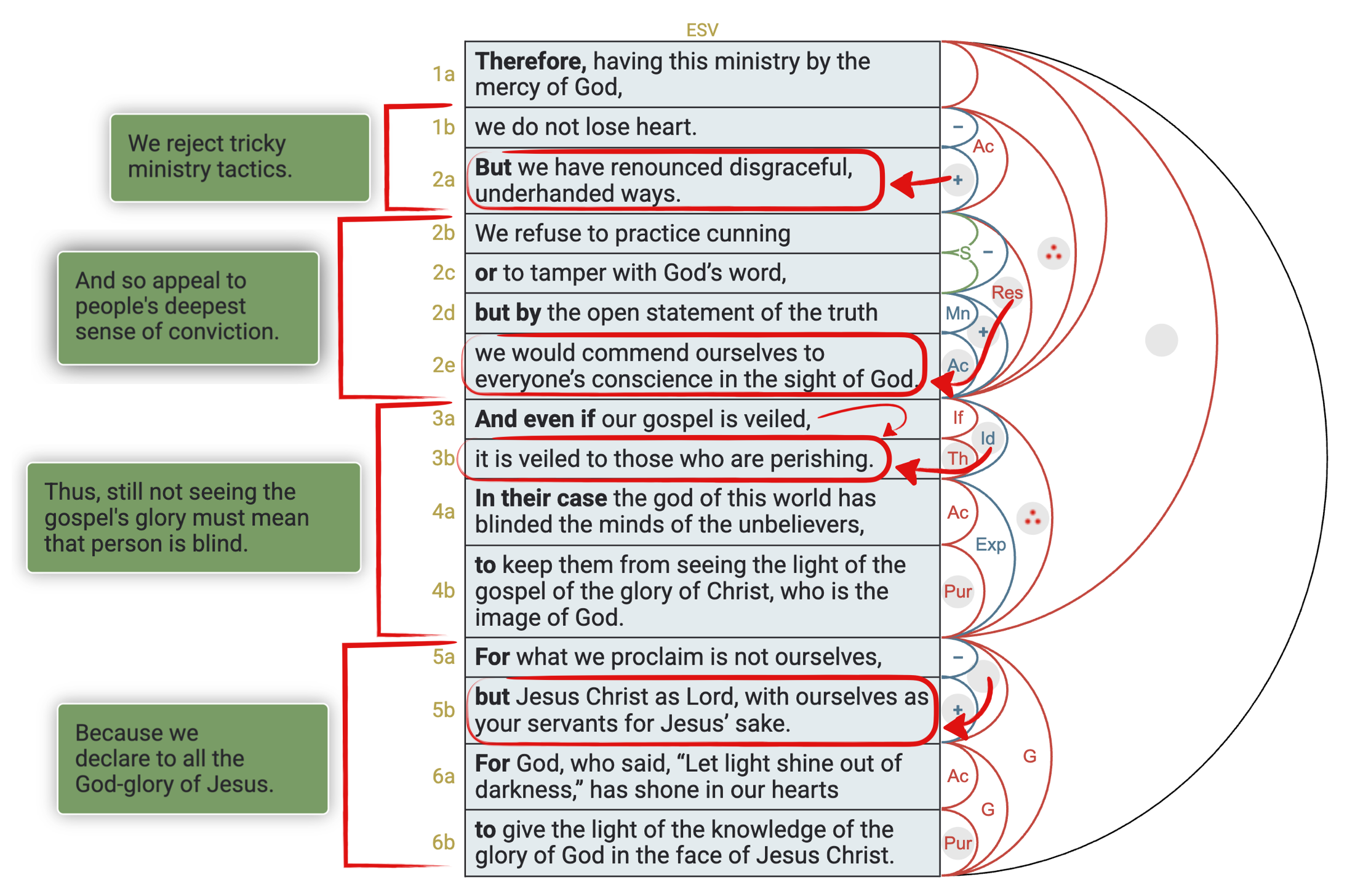
Let’s put some of the pieces together (pun intended!) with an example from our last assignment. Be sure to notice where the idea from a subordinate proposition was necessary to incorporate into a sub-point summary.
2 Corinthians 4:1-6