Lesson 4 | Grammatical Logic
Stumped: A Non-Sequitur
”The safe was empty when we arrived; that must be why the coffee pot was left on!” This sentence is an example of a non-sequitur. When we read sentences like these, we experience the queasy sense that there is a disconnect, or a gap in logic, between two statements. The detective must always be careful not to settle on conclusions that result from fuzzy non-sequiturs inserted into his thinking.

In The Yellow Face by Arthur Conan Doyle, an extraordinary case is brought to Sherlock Holmes. Mr. Grant Munro and his wife have been happily married for three years—until trouble arises when new neighbors move into the cottage across the field. Mrs. Munro begins sneaking out of the house at night, a mysterious masked face is seen in the window of the neighboring cottage, and when Mr. Munro charges into the cottage to get to the bottom of the mystery, he finds a portrait of his wife in the only inhabited room! Perplexed by his wife’s refusal to explain, he turns to Holmes for help and recounts the entire story.
‘I am afraid that this is a bad business, Watson,’ said my companion, as he returned after accompanying Mr. Grant Munro to the door. ‘What do you make of it?’
‘It had an ugly sound,’ I answered.
‘Yes. There's blackmail in it, or I am much mistaken.’
‘And who is the blackmailer?’
‘Well, it must be the creature who lives in the only comfortable room in the place, and has her photograph above his fireplace. Upon my word, Watson, there is something very attractive about that livid face at the window, and I would not have missed the case for worlds.’
‘You have a theory?’
‘Yes, a provisional one. But I shall be surprised if it does not turn out to be correct. This woman's first husband is in that cottage.’
—Arthur Conan Doyle, “Adventure II: The Yellow Face,” The Memoirs of Sherlock Holmes. Emphasis added.
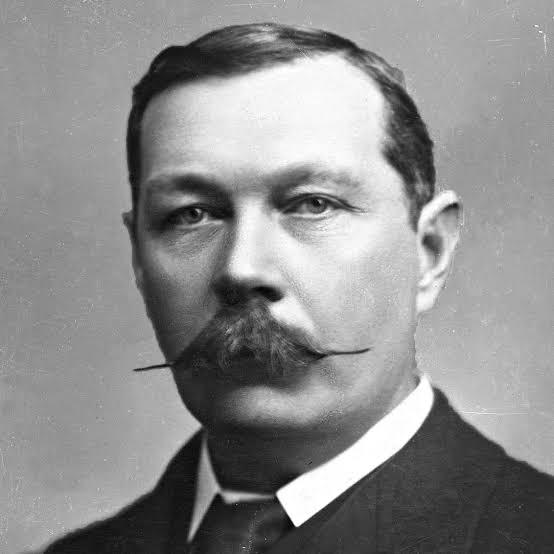
Holmes and Watson travel to Norbury to uncover the villainy. Arriving, they push past Mrs. Munro's desperate pleas and burst into the room—only to discover a little girl! Mrs. Munro's former husband had died, leaving her separated from her only daughter. Fearing her new husband's reaction, she had kept the girl's existence a secret. Holmes had correctly observed several clues, but had, uncharacteristically, left logical gaps between them. His failure to connect the dots led to one of the more embarrassing misjudgments of his career.
‘Watson,’ said he, ‘if it should ever strike you that I am getting a little over-confident in my powers, or giving less pains to a case than it deserves, kindly whisper ‘Norbury’ in my ear, and I shall be infinitely obliged to you.’
Arthur Conan Doyle, “Adventure II: The Yellow Face,” The Memoirs of Sherlock Holmes.
Like Holmes, the Bible paraphraser can unwittingly leave logical gaps between the propositions of his paraphrase. Though each may be paraphrased beautifully—with vivid description, helpful context, and interpretational clarity—one idea does not naturally flow from the previous one. When read as a whole, the paraphrase leaves the reader with that same queasy feeling that the dots don't line up. It becomes a non-sequitur.
We cannot stress enough the importance of reading and rereading. Once you have divided the letter into its logical parts or sections, you will want to begin the study of every section precisely the same way. Read and reread; and keep your eyes open!
—Gordon D. Fee and Douglas Stuart, How to Read the Bible for All Its Worth, 2nd ed. (Grand Rapids, MI:
Zondervan, 1993), 50.

A Non-Sequitur from John 1:18
Consider the following paraphrase. As you read it, do you get the sense a non-sequitur is happening?
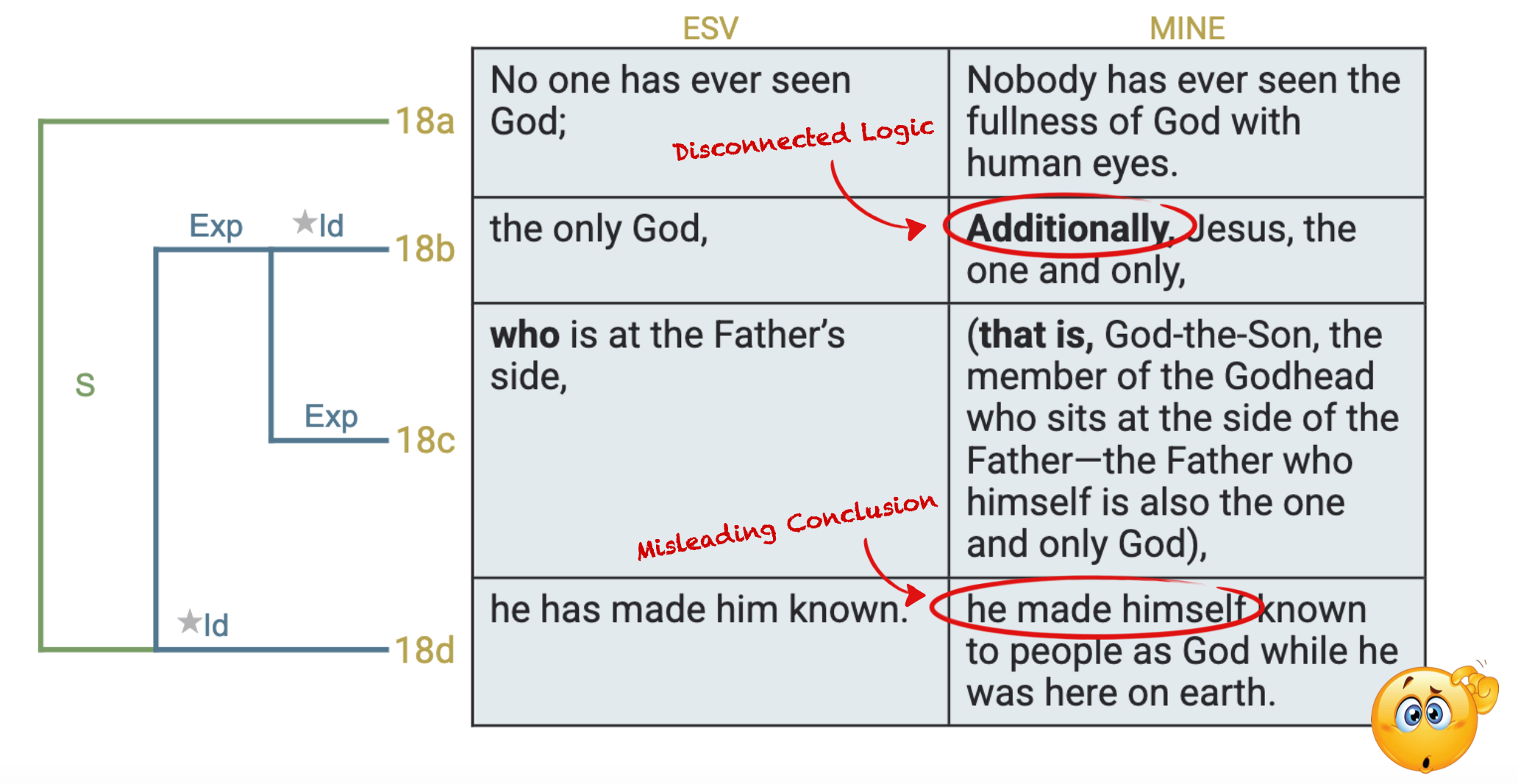
By assuming the semicolon in 18a is moving us on to a new, independent thought (represented by the Series relationship), our representation of this verse is left painfully segmented. “Point 1: Nobody has ever seen God. Point 2: Jesus made his divine nature known while on earth.” But what do those have to do with one another?
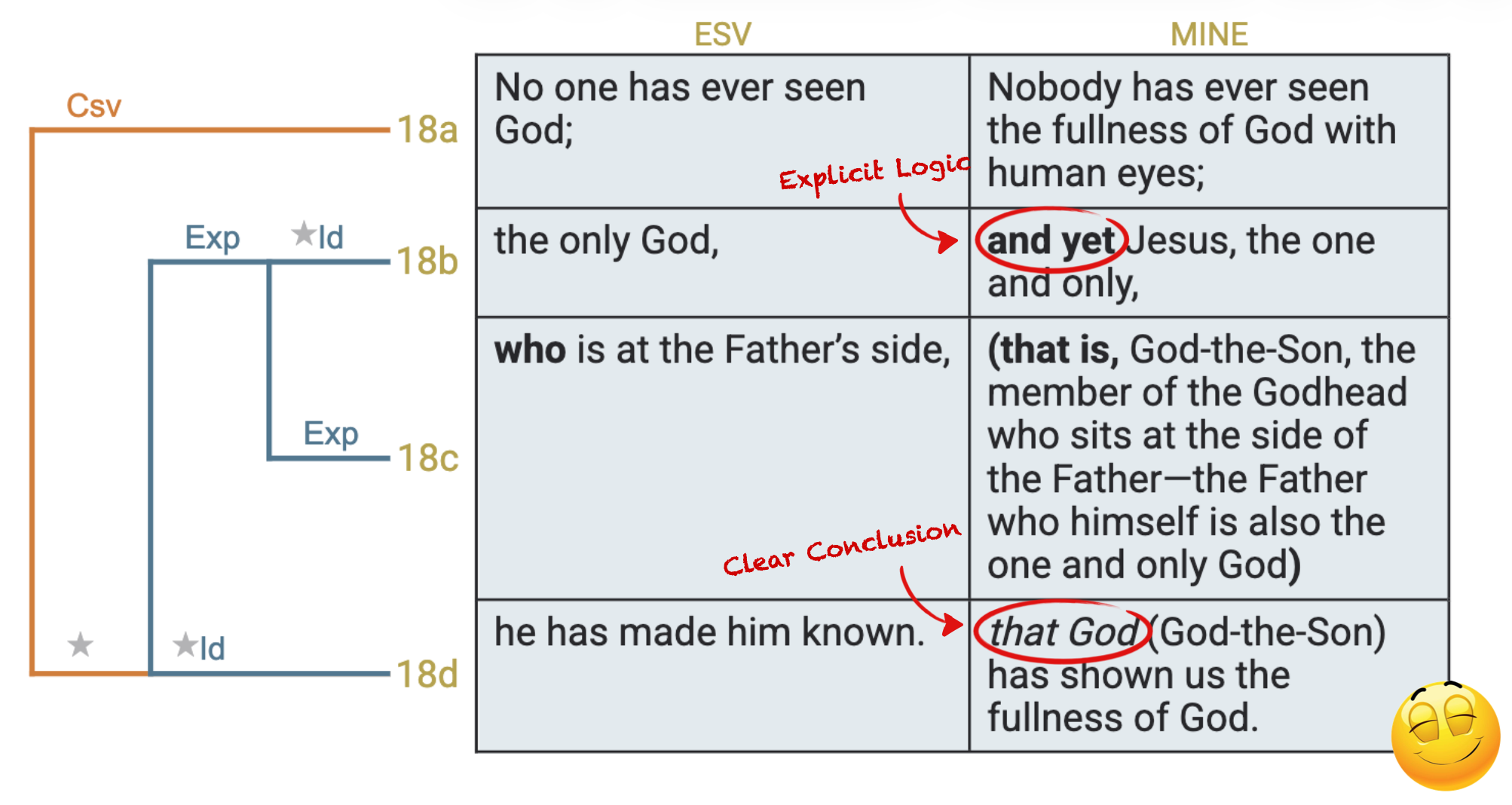
This paraphrase makes much more sense. Since the unnamed connector in 18b is now explicitly communicated as a Concessive in the paraphrase, the logic of the rest of the passage falls into place—even though nobody has seen God, Jesus has revealed him!