Lesson 10 | Main Point Summary
Pleasing the Lord, Persuading Others
As we consider these principles for writing a main point summary, let us revisit 2 Corinthians 4:16–5:11 (our assignment passage from the last lesson) and finish it with a main point summary. For the sake of preserving simplicity, I have not included the sub-point summaries or paraphrase, but you can feel free to pull up the instructor’s work from Lesson 9 and compare if need be.
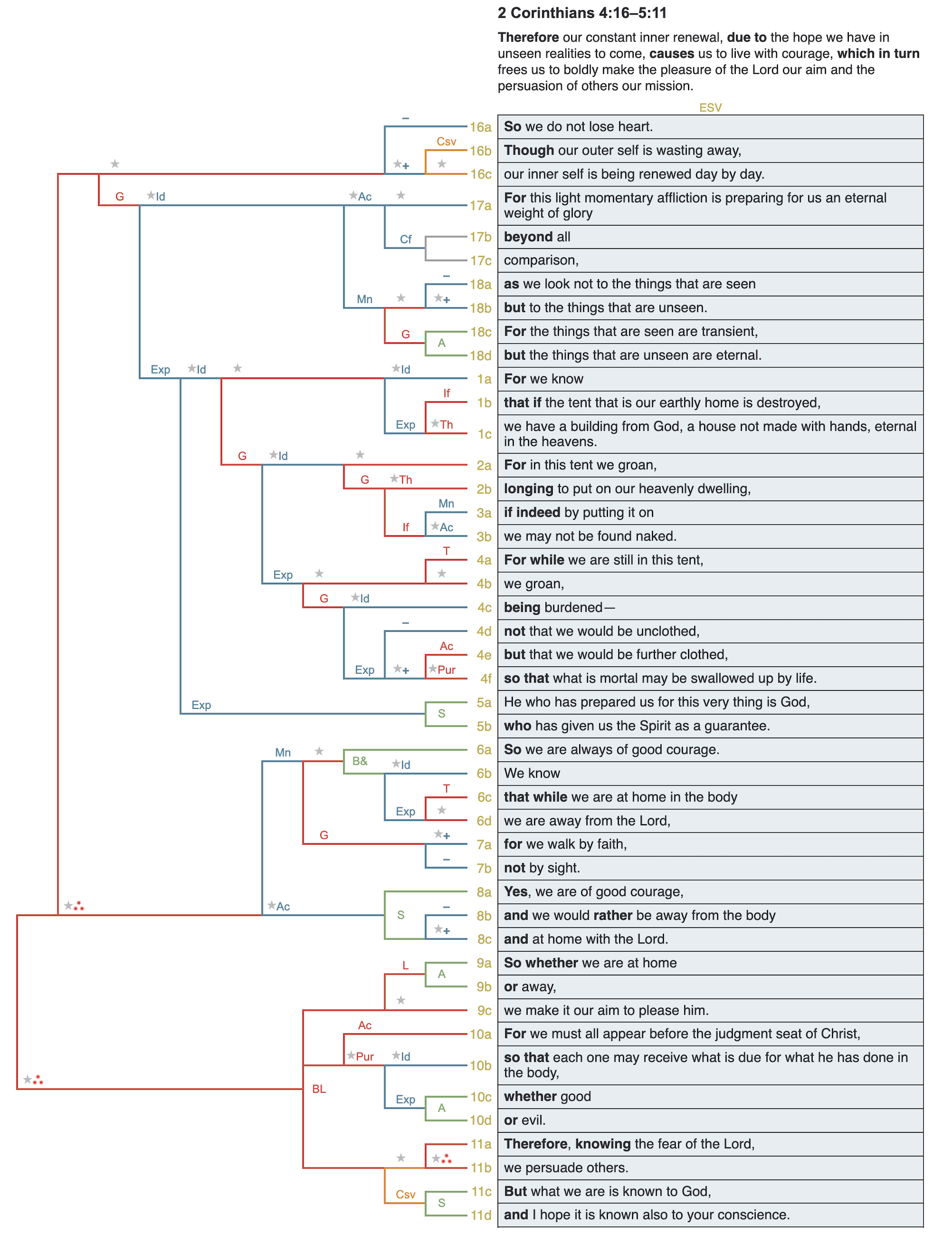
Notice the following:
- I have identified 5:1–5 as an Explanation that, though important, is an aside. Therefore, I have not included this portion explicitly in the main point summary as I felt it unnecessary to emphasize the conclusions Paul comes to at the end.
- Our main point summaries should seek to pin down the author’s central concern by answering Who?, What?, When?, Where?, Why?, and How? appropriately. In this passage, I especially had to ask why questions related to the last two “So…” pieces (5:6–8, 5:9–11). Why does Paul declare our courage, and why does he conclude that we must make it our aim to please God and persuade others? What previous points in the passage lead to those conclusions?
- Whereas my sub-point summary of 4:16–5:8 flipped the order of the pieces behind the Inference, I was able to restore that ordering in my main point summary. (That said, rearranging is still permitted in your main point summary when doing so brings clarity.)
- I was able to carefully shape my main point summary into one complete (albeit somewhat long) sentence. This is a good goal.
- As with sub-point summaries, my main point summary maintains the same perspective as the author. This is a rule.