Lesson 4 | Grammatical Logic
Other Grammatical Markers
In addition to those already mentioned, there are a handful of other grammatical markers that will assist you in being explicit in your paraphrase.
1. Catch the Tense of a Verb
Verbs morph and transform with more variety than any other kind of word, forcing us to consider the biblical author’s choice of tense in our paraphrase. The tense of a verb can also lead to a helpful understanding of the logic of a passage. If one proposition is in the present tense, and the next is in past tense, it raises the question “Why?”. Thus, making explicit the tense of a verb in a paraphrase serves as a tool for discovery.
The Prophetic Past Tense
...and those whom he justified he also GLORIFIED.
Romans 8:30
...and because he forever declared them righteous at the moment of salvation, he has prophetically made them glorious already with the glory that he has promised them.
The Conditional “Already”
For we HAVE COME to share in Christ, if indeed we hold our original confidence firm to the end.
Hebrews 3:14
For we have already begun now to enjoy all that Christ lavishes upon those who are his if, at the end of the road, we are found still confident of the gospel message that first introduced us to it.
2. Utilize the Voice of a Verb
It is commonly considered unpopular to speak in passive voice in our day, but that has not always been true throughout history. Active and passive verbs are intentionally utilized for different purposes throughout the Old and New Testament text.
Though the meaning of the sentence ”Jack read his Bible” is preserved in the sentence “The Bible was read by Jack,” there is an important difference. The latter, utilizing the passive voice, takes the emphasis away from Jack and puts it on the Bible. Subtle nuances like these are intentional throughout Scripture and so must be observed by anybody wanting to write an accurate paraphrase.
But it isn’t as simple as maintaining the voice of the text in the Paraphrase. There are times that you certainly should replicate the voice of a verb in your paraphrase, but other times where altering it can bring more clarity.
Active Next to Passive
You have heard that IT WAS SAID to those of old...but I SAY to you...
Matthew 5:21–22
You have learned in your Torah schools that certain laws were spoken to the ancient ones…But today, in contrast to that, I, in all my authority, tell you what this law truly means…
Paraphrasing the Divine Passive Actively
Blessed are those who mourn, for THEY SHALL BE COMFORTED.
Matthew 5:4
Those who mourn the effects of sin are blessed by God, because he will personally comfort them in their sorrow.
3. Restate Rhetorical Questions
Rhetorical questions fill the pages of the Bible, and offer a unique challenge. In order to properly paraphrase them, we must first look to see if Scripture answers the question being asked. If there is no answer, we have a rhetorical question on our hands.
A rhetorical question is a way of making a statement, while adding a degree of emphasis, or maybe even incredulity. So the best way to get your head around how a rhetorical question logically connects is to use your paraphrase to turn it into a statement. After you do this, you can start testing how the logic of the passage works.
Consider this example from Isaiah 40:27–28.
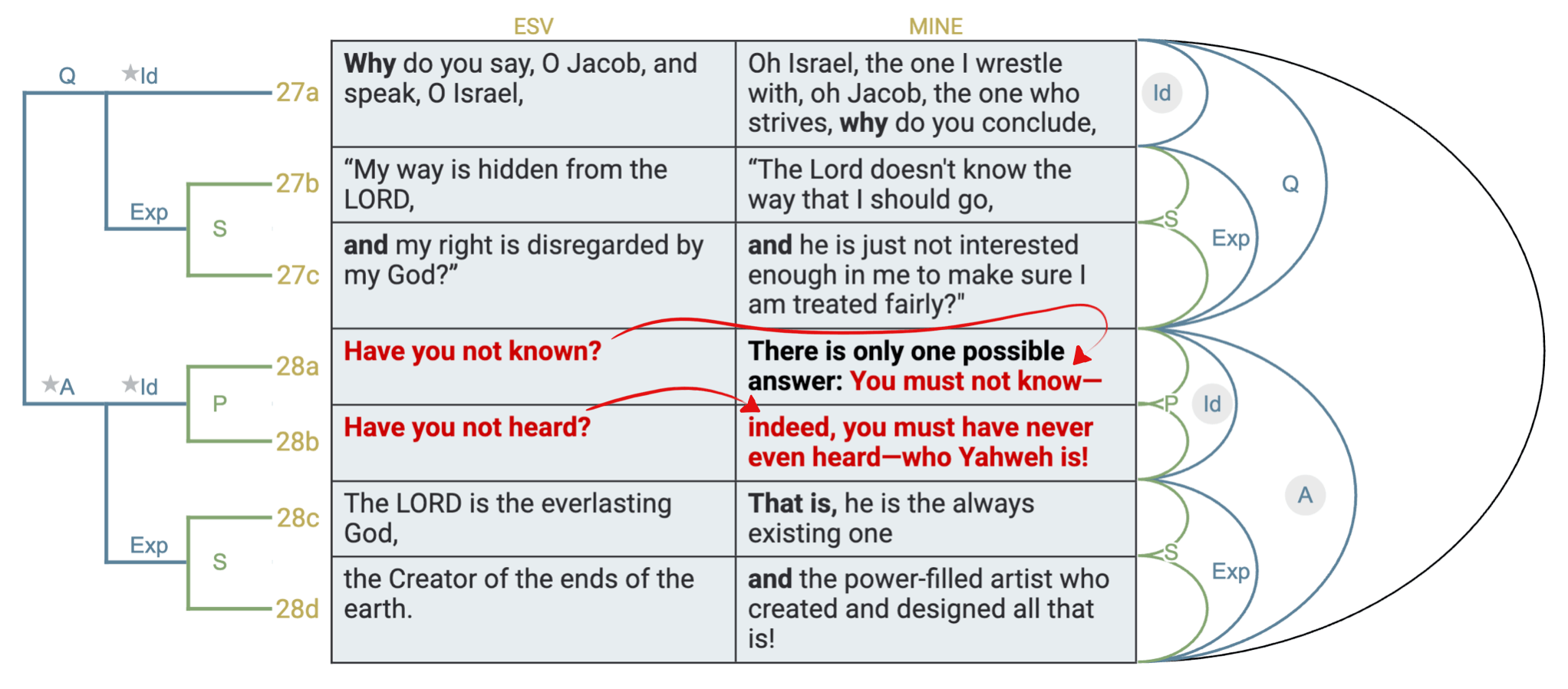
The two rhetorical questions are found in 28a and 28b. Notice that they are paraphrased as statements in order to properly capture their meaning. Having done that, it is now clear that Isaiah is actually answering his originally question from v. 27 with the rhetorical questions of v. 28. “Why does Israel speak that way?” Answer—“They must not know who Yahweh truly is.” The prophet then goes on to explain who he is with some of the most life-giving descriptions in the Bible.
Paraphrasing Principle
To test out the logic of a rhetorical question, restate it as a statement in the paraphrase.