Lesson 4 | Grammatical Logic
Paraphrasing Relative Clauses
The flea that lived on the cat that chased the bird that ate the caterpillar that fed on the plant that grew in the garden that flourished in my yard...
Relative clauses are powerful. They carry the unique ability of unpacking a noun or idea succinctly, without adding on a new sentence. In the Bracketing course, you learned when to divide relative clauses; here, you will learn to identify the logic they convey.

What is That Relative Clause Doing?
The only relative clauses that concern us are those with a non-defining role. Those with a defining role are simply clarifying what is being talked about. (E.g. “A man who is kind benefits himself.”) But those without a defining role are doing something else. Our goal is to trace down what that “something else” is. (If you need to a refresher on when to divide a relative clause, briefly return to this page of Bracketing to explore the principles found there.)
First, identify what noun or idea the relative pronoun is referring back to. Then, determine why the author felt it important to include this non-defining idea in the flow of his writing. Answering that question will help you determine the relative clause’s logic.
For example...
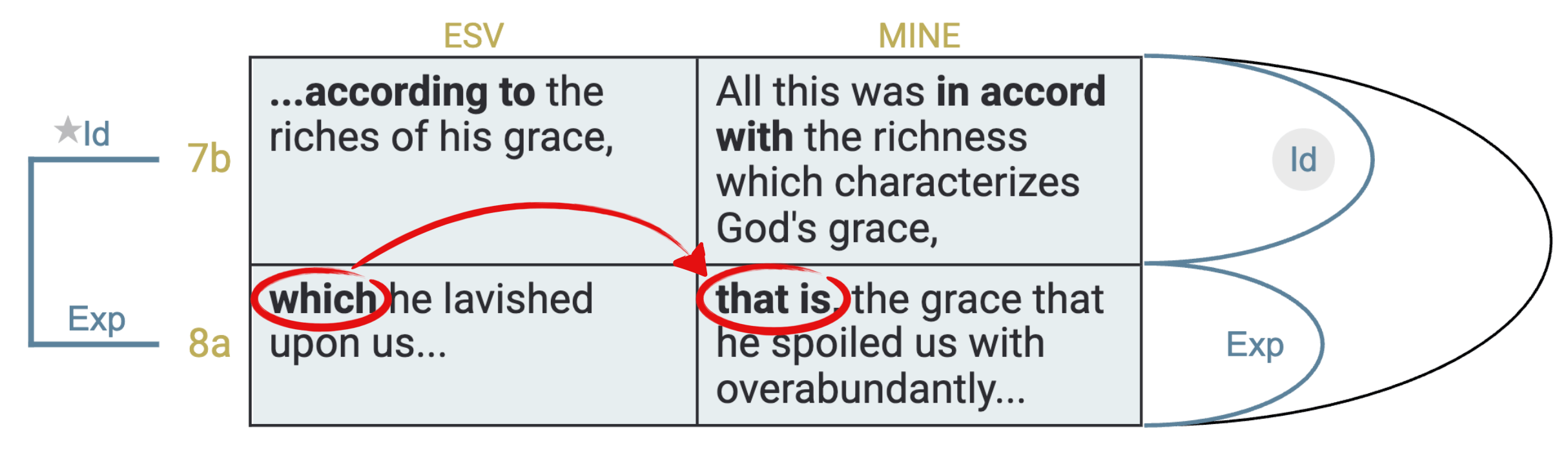
Idea-Explanation: Ephesians 1:7–8
In this case, the relative pronoun “which” refers to the word “grace.” In this worship-laden blessing to God at the beginning of Paul’s epistle to the Ephesians, he is layering on more and more of the glories of the gospel. This appears to be the simple reason why 8a is included—Paul simply wanted to explain more about this grace. That is, we know how rich God’s grace is through experience!
Ground: Philippians 3:20–21
Though relative clauses can often be paraphrased as explanations, the biblical author may be doing something deeper, implying beautiful theological truths and connections through the subtlety of a relative pronoun.
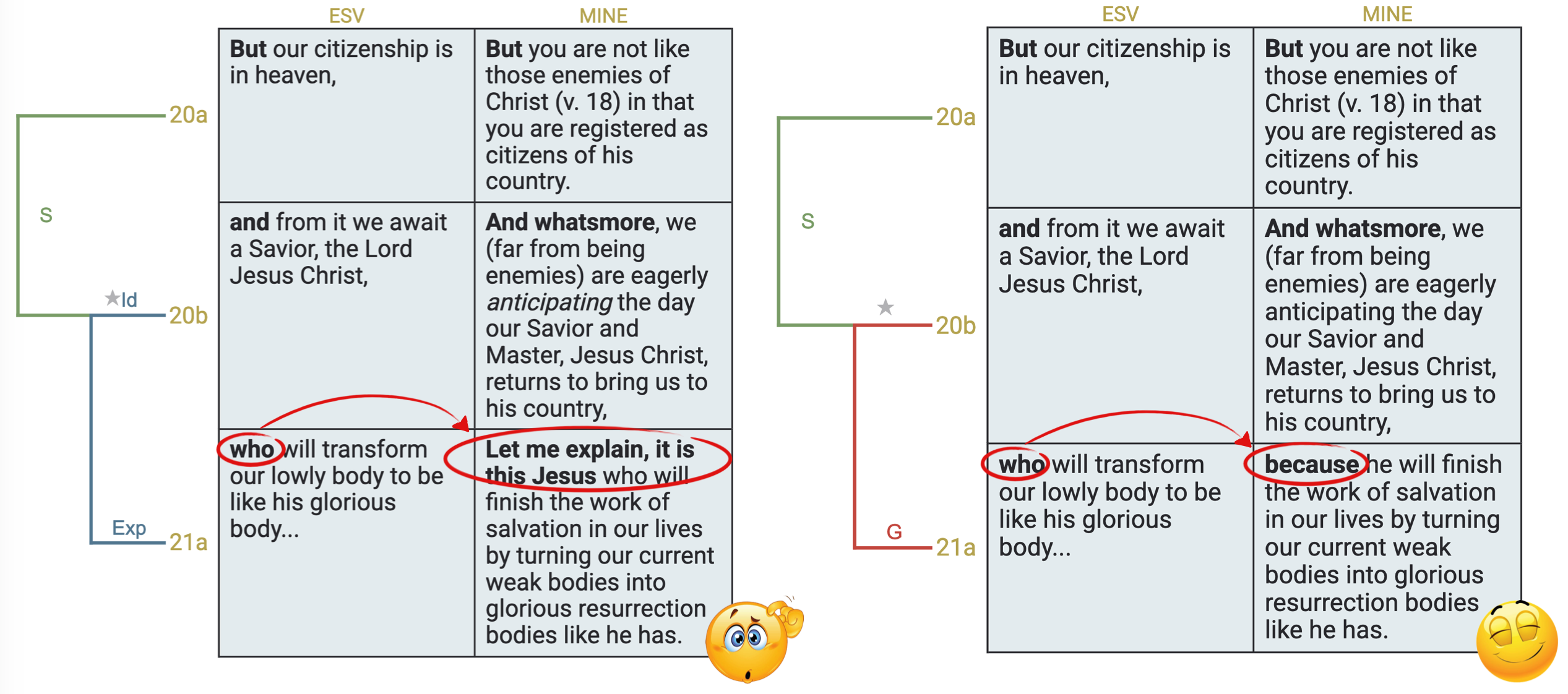
Consider the bracket and paraphrase on the right. The “who” refers to “the Lord Jesus Christ.” But is Paul using the relative clause to simply add information about Jesus, as the an Idea-Explanation would suggest? No, he is doing more. The transformation that he will accomplish in us (21a) is the reason that we are eager for his return (20b).
Result: Titus 2:14
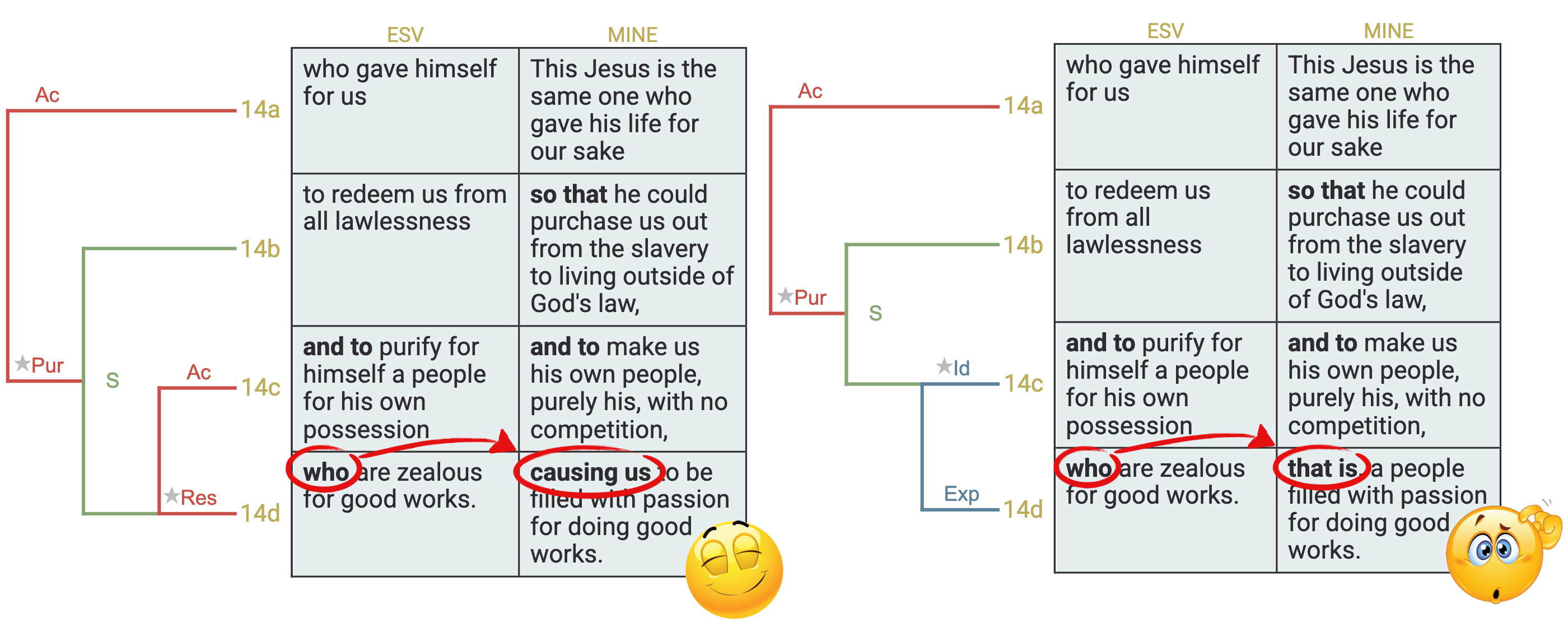
In this example, the paraphrase on the right is a legitimate possibility—Paul could be simply describing the “people” from 14c. But the content of 14d is quite distinct from 14c. Upon further consideration, there is a cause-and-effect chronology here, that is, God's purifying work is what causes passion for good works in our hearts. Thus, we have utilized the testing ground of the paraphrase to move from Idea-Explanation to an Action-Result.
There are many other possible ways to logically paraphrase a relative clause, including Temporal, Concessive, Locative, and Manner. They are rare. Yet, when you stumble upon them in your studies, don’t hesitate to put them to the test in your paraphrase.