Lesson 3 | Paraphrasing the Logic
The Importance of Logic
To understand what a biblical author is saying, it’s not enough to simply comprehend his topic. We must also grasp the flow of his thoughts. You know this from learning Bracketing or Arcing. It is essential to discern the connections between the units of thought—connections that are often made by common, simple, easily-overlooked words called conjunctions—words that form vital links in a chain. The following blog post by Dan Brendsel helpfully articulates the truth that it is the little words that can make the biggest impact.
It is of utmost importance to realize that Scripture argues. It doesn’t just give pearls on a string that we can take away individually and reflect upon. It reasons with us, argues a point, tries to persuade us of particular realities and toward certain ways of living. And it is of great benefit for us to grasp those arguments, see how they work, trace them from beginning to end, and discover the deep power in them for life-change.
...Scripture is not just a collection of energy packets; it’s a five-course meal. It’s not just a bunch of pearls on a string; it’s a chain strong enough to pull you out of any trial.
...One of the first things to consider is also one of the most inconspicuous and unobtrusive — namely, the little words of Scripture. It is the conjunctions (like ‘and’ and ‘but’), the prepositions (like ‘in’ and ‘on’), and the adverbs (like ‘well’ and ‘fully’) that tip us off to an author’s train of thought, to how one clause relates to another, to how one paragraph builds on that which precedes and prepares for that which follows. Paying attention to these little words opens up for us big worlds of thought and theology and practice and living.
...There is big significance in the little words of Scripture. They are God’s gift to help all of us ‘eat this book’ for our health and life. You need not be a world-class theologian, and know all the big words and technical terms, to read your Bible and understand it. In fact, it’s actually the simplest little words — the ones we’re all familiar with — that most often change everything.

 You Life Depends on Little Words
Dan Brendsel, “Your Life Depends on Little Words,” The Gospel Coalition.
So whatever you wish that others would do to you, do also to them…
Jesus
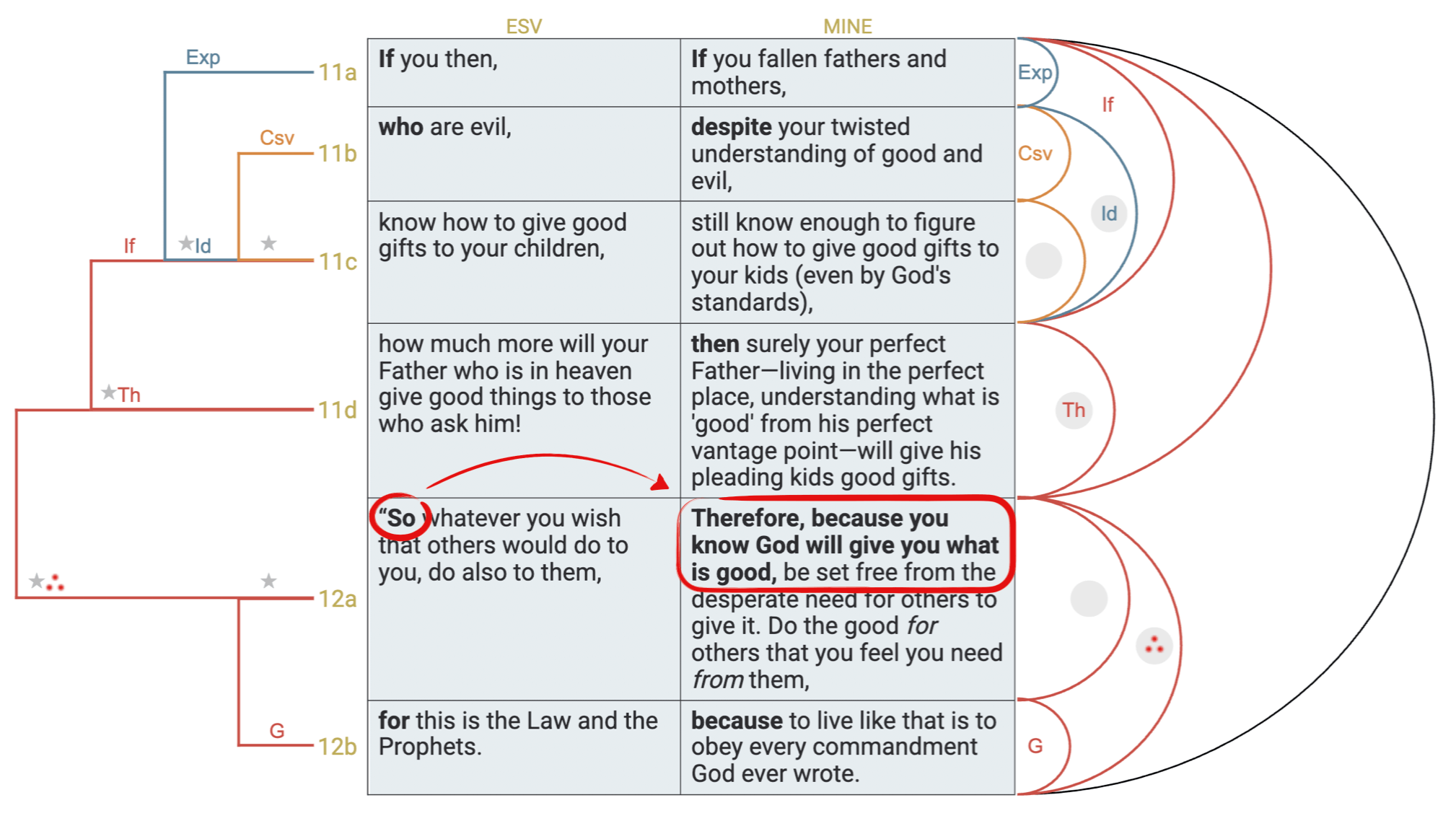
Or take this very familiar verse, the Golden Rule, from Matthew 7:12. Have you ever considered that this verse begins with the word “So…”? Pastor and writer Steve Fuller helpfully unpacks the value of this little word.
Here Jesus calls us to do as much good for others as we want others to do for us. But if we are honest we will ask ‘What about us? Who’s going to do good for us?’ Jesus loves that question. And He Himself answers that question, in—
The most important word in the Golden Rule
It’s the word ‘so,’ which means ‘therefore.’ Look at the verse again—
So whatever you wish that others would do to you, do also to them.
The word ‘so’ shows that obeying this command depends on understanding the previous verse—verse 11—
If you then, who are evil, know how to give good gifts to your children, how much more will your Father who is in heaven give good things to those who ask him!
Here Jesus promises that whenever we ask, our Father in heaven will always do good for us (especially the greatest good of giving us more of Himself). We first must understand that God will always do good for us (v. 11)—so therefore we can devote ourselves to doing good for others (v. 12).
How to obey the Golden Rule
Jesus does not want us to obey the Golden Rule by gritting our teeth and ignoring our own needs so we can care for the needs of others.
He wants us to obey by first trusting all our needs to our Father in earnest prayer—resting in the fact that He is rejoicing to do us good with all His heart and soul.
Then—trusting that God is passionately pursuing us with good—we can devote ourselves to doing good for others.

 How Can We Obey the Golden Rule
Steve Fuller, “How Can We Obey the Golden Rule?,” Living By Faith Blog.