Lesson 3 | Paraphrasing the Logic
Clear Conjunctions
It is of utmost importance that the logic of your paraphrase reflect both the logic of the passage and of your bracket or arc. In order to accomplish this, you must learn how to paraphrase conjunctions.
Conjunction
a word used to connect words, clauses, or sentences
This step will train you to reflect the logic of a passage in a paraphrase when the conjunctions are clearly stated and unambiguous.
Alignment: Left to Right
Have you ever finished a bracket and still felt unsure whether it really reflected the logic of your text? To address that uneasiness, we teach the Arcing/Bracketing student to make conjunctions bold in each column. You may have noticed this pattern in Biblearc instructor’s work—it is intentional. Bolding conjunctions helps to keep the logic in one column aligned with the other, and with the bracket as a whole. If your paraphrase aligns with your bracket and with the passage, you're entering solid interpretational ground.
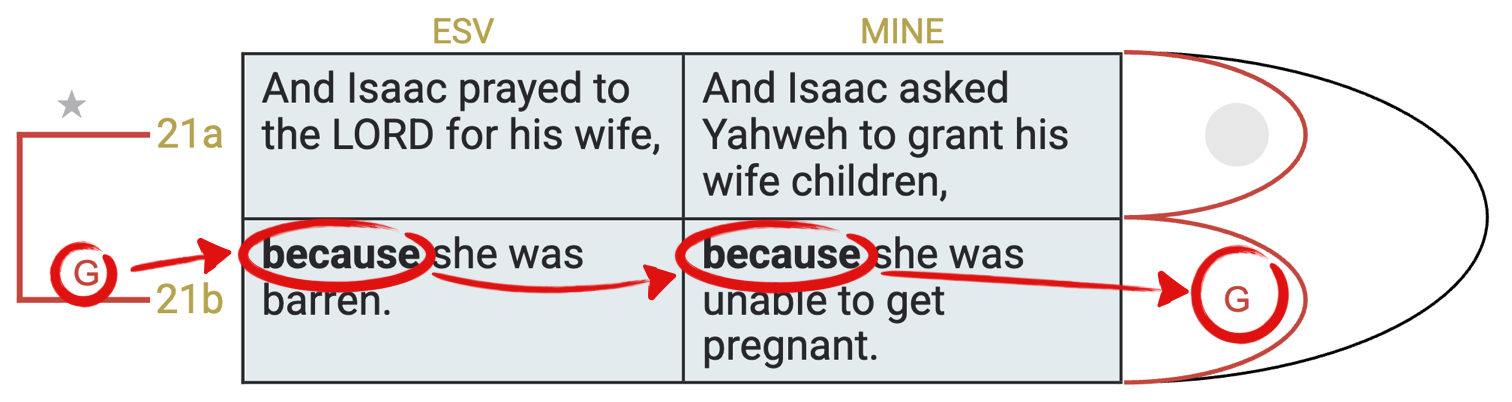
Bold every conjunction in every column of your arc/bracket.
Restating the Same Conjunction
If the conjunction used in Scripture is clear and explicit, simply restate the same conjunction in the paraphrase.
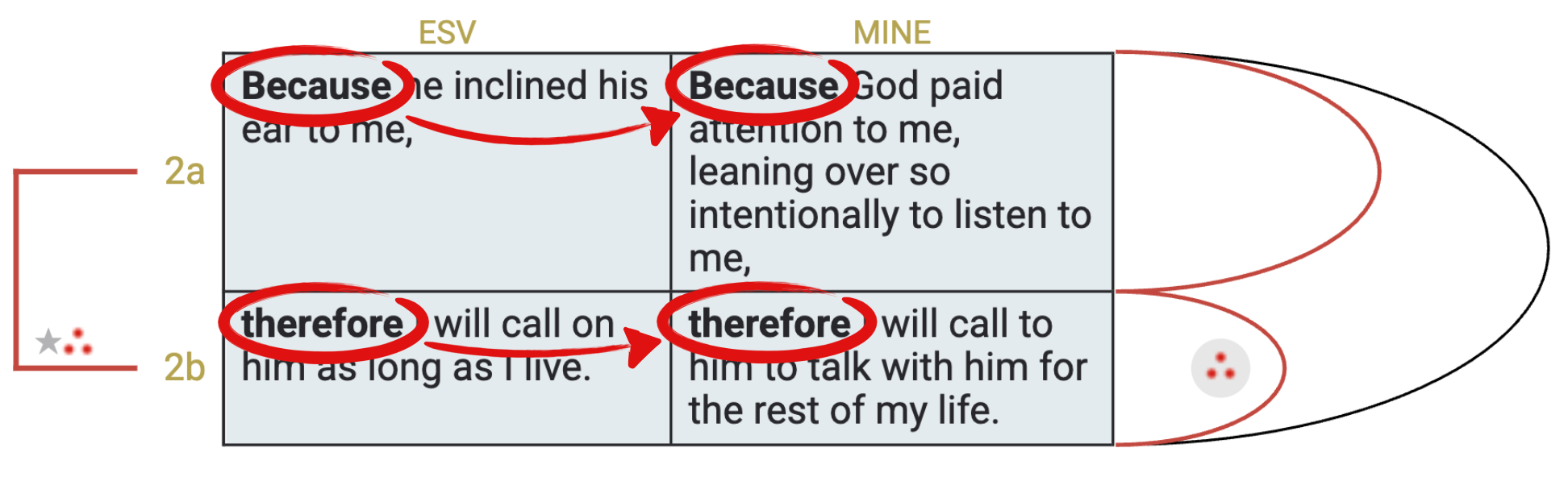
Paraphrasing a Conjunction
However, there are good reasons to alter the wording of a conjunction in the paraphrase. Here are two.
- As an exercise, to experiment with different words and capture a more precise meaning.
- As a rhetorical tool, to draw attention to major shifts in the passage’s flow of thought.
The first and easiest way to begin making adjustments is to use a synonymous conjunction. Consider this example from Numbers 13:27–28.
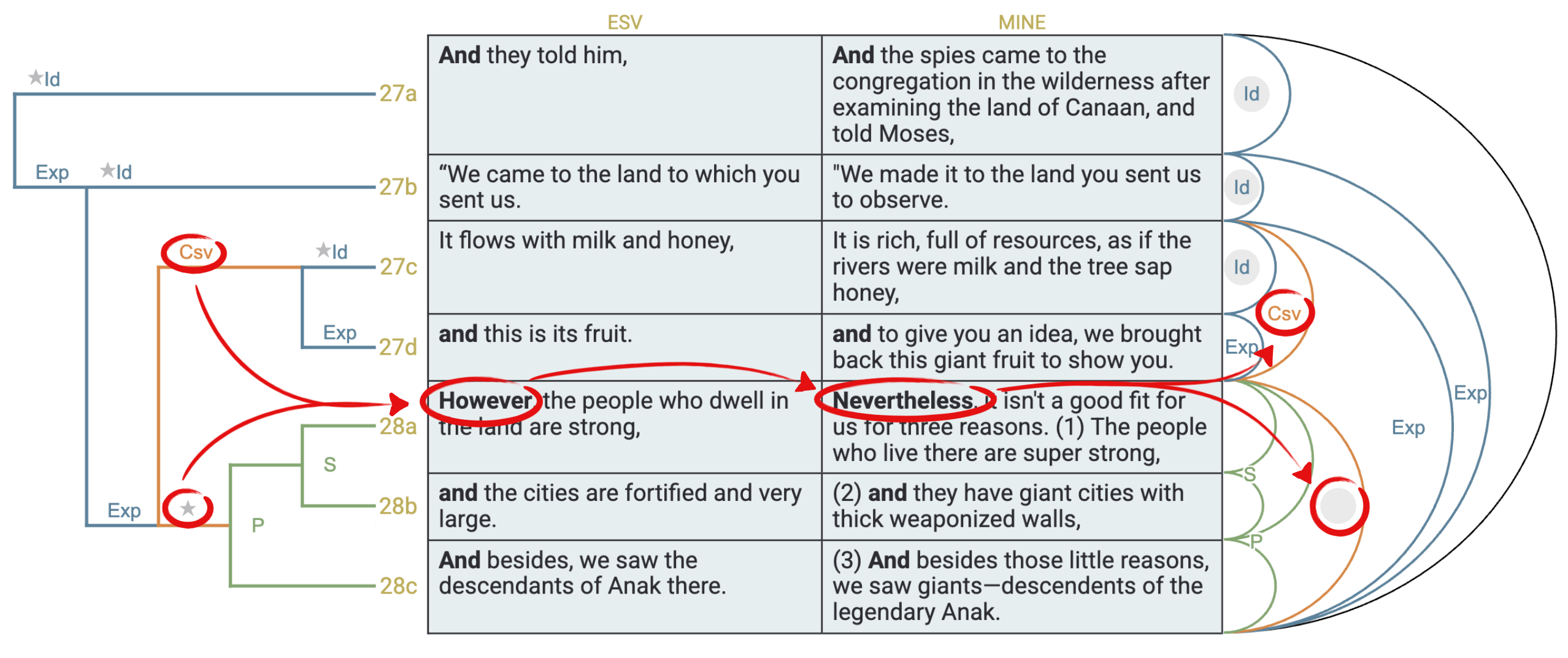
In the example above, “however” was paraphrased as “nevertheless” to highlight a major shift in the passage’s flow of thought. As the spies returned from Canaan, it is clear they had reasoned out an argument against going into the land. Though they couldn’t hide the abundance of the land, on account of fear they sought to present these “positives” as mere concessions. The word “nevertheless” captures this calculated reasoning.
Remember, however, that the goal of a paraphrase is to add clarity, not take away from it. Because some synonymous conjunctions are less precise than others, adding them may actually make your paraphrase less explicit than the text. (We will talk more about ambiguous conjunctions in the next step).
You may also find it helpful to use a conjunction phrase. Here is an example from Nehemiah 2:1–2.
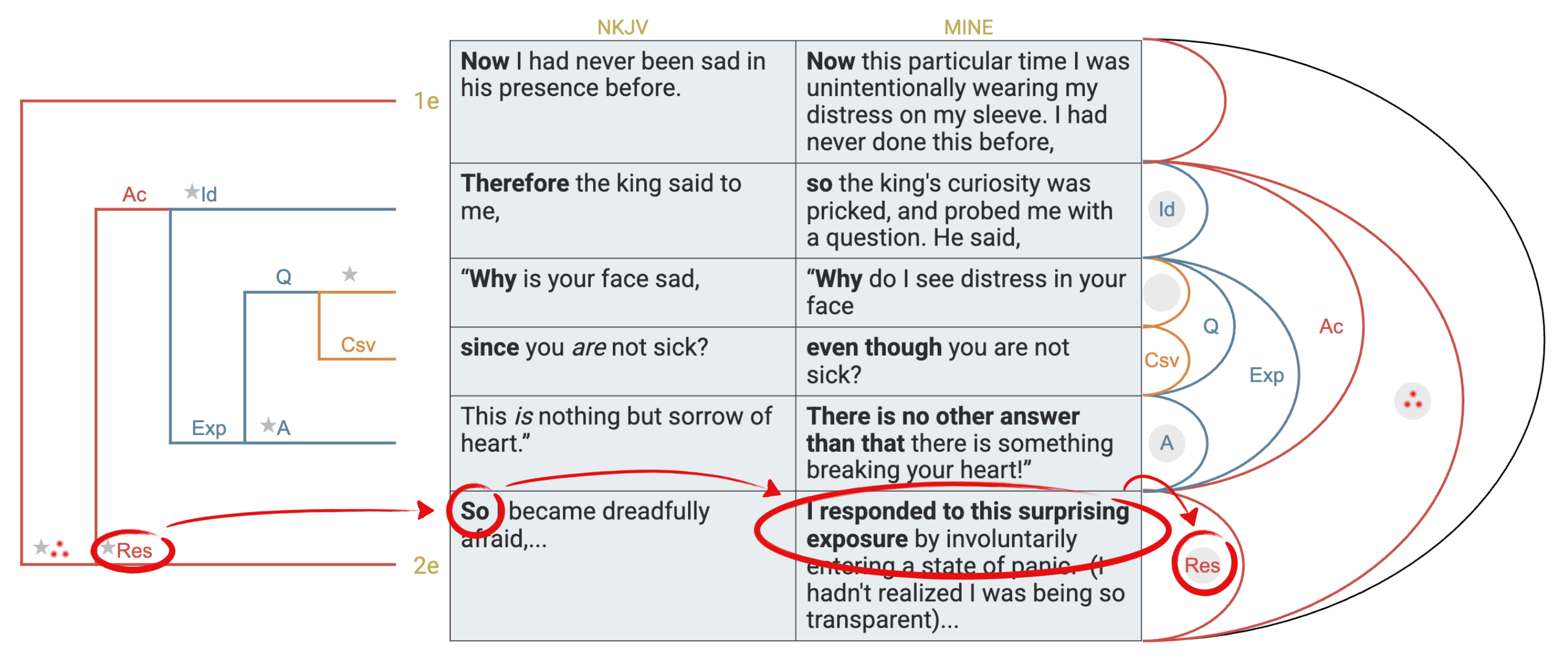
Nehemiah’s emotional response marks a major turning point in the narrative. The conjunction phrase “I responded to this surprising exposure” unpacks his knee-jerk reaction, setting us up to better understand how the story continues to unfold.
It's Not Always So Straightforward
You may be thinking, “that all seems like common sense,” and it is—much of the time. But unfortunately it isn’t always quite as straightforward as the examples above. Did you notice that in the previous example I paraphrased “since” as “even though”? When testing out the conjunction “since,” I struggled to paraphrase the common logic behind it (normally a ground) in a way that made sense! Consider this attempted paraphrase:
“Why do I see distress in your face because you are not sick?”
That paraphrase leaves me scratching my head. Considering that 2b–c was a real question, answered in 2d, I was left picking my way through testing conjunctions to see what logic might actually be intended. This landed me on the concessive, and I understood that the king used “since” to tell Nehemiah the reason he had already ruled out.
On the next step, we will further consider the question of problematic conjunctions.
 English Conjunctions Cheat Seatpdf
If you need a refresher on conjunctions and their logical relationships, keep this sheet in hand as you begin paraphrasing.