Lesson 3 | Paraphrasing the Logic
Problematic Conjunctions
Sometimes, like a pesky puzzle piece you’ve unsuccessfully tried to smash into place, you can’t make a conjunction fit the flow of the passage. There are are various reasons a conjunction can be problematic. Let’s explore them.

Ambiguity in the Conjunction
Many conjunctions aren’t limited to one single, clear-cut logical relationship. If all logic could be as clear as the word “therefore,” the puzzle pieces of our paraphrase would never get bent out of shape. But that is not how language works. Many conjunctions are inherently ambiguous—capable of expressing a range of logical relationships.
Key Ambiguous Conjunctions
Conjunction
Relationships
“but”
- Alternative
- Negative-Positive
- Concessive
- [Situation-Response]
- [Action-Manner]
“for”
- Idea-Explanation
- Ground
- [Action-Result]
- [Action-Purpose]
“that”
- Action-Result
- Action-Purpose
- Idea-Explanation
“then”
- Progression
- Inference
- Conditional
- [Concessive]
- [Temporal]
Loading...
The above chart is a great reference to look back on, but Bible students who use Biblearc are blessed to have these references built right into the Arcing/Bracketing module. To gather options for your paraphrase:
- Type in your passage’s conjunction in the search bar to reveal the relationship possibilities.
- Select the logical relationship you think fits the passage.
- Experiment with a few of the conjunctions that appear, especially the highlighted one.
- See if your paraphrase aligns left-to-right and makes sense top-to-bottom.
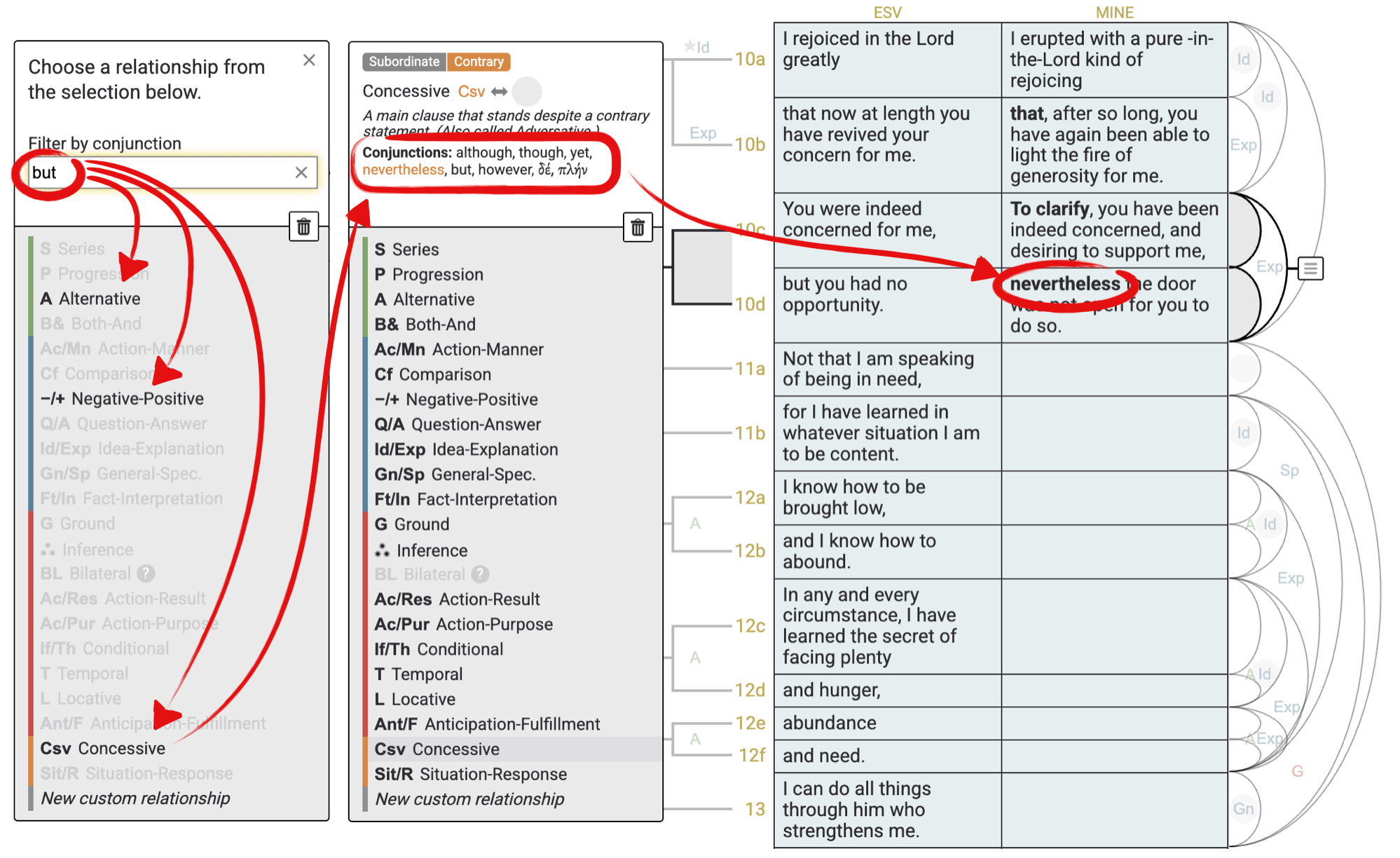
When you find an ambiguous conjunction in the text, the paraphrase becomes a proving ground to determine the best fit. Remember, the goal is to remove ambiguity, not add it, so don't settle on a conjunction until it sharpens the meaning.
A Pesky Conjunction in Action
There are times when the relationship choice seems obvious, until your paraphrase doesn’t make sense and you’re left scratching your head. Such was the case for me in Galatians 6:3.
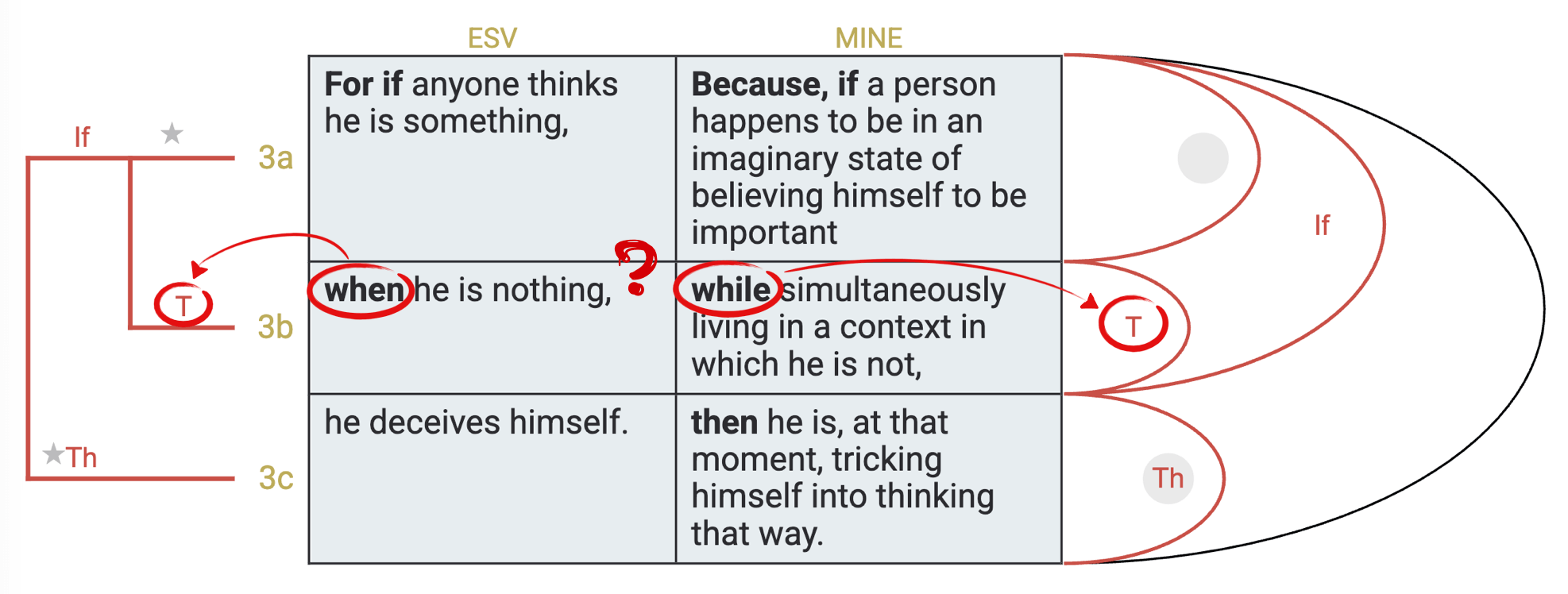
When I first came to the ESV passage, it seemed like an easy bracket and paraphrase, until I started trying to make sense of the first two propositions. Is it really true that the self-deceiver is one thinking highly of himself at a certain time? That interpretation would call a proud man self-deceived only when he isn’t holding an important position in life. Paupers can thus deceive themselves, but presidents cannot?! Certainly this is not Paul’s point.
So I needed to press into that pesky conjunction “when.” Normally, this conjunction indicates a strict temporal relationship, but here the content points to something more universal in nature. As I considered the contrasting ideas represented in the words “something” and “nothing,” the possibility of a Concessive formed in my mind.
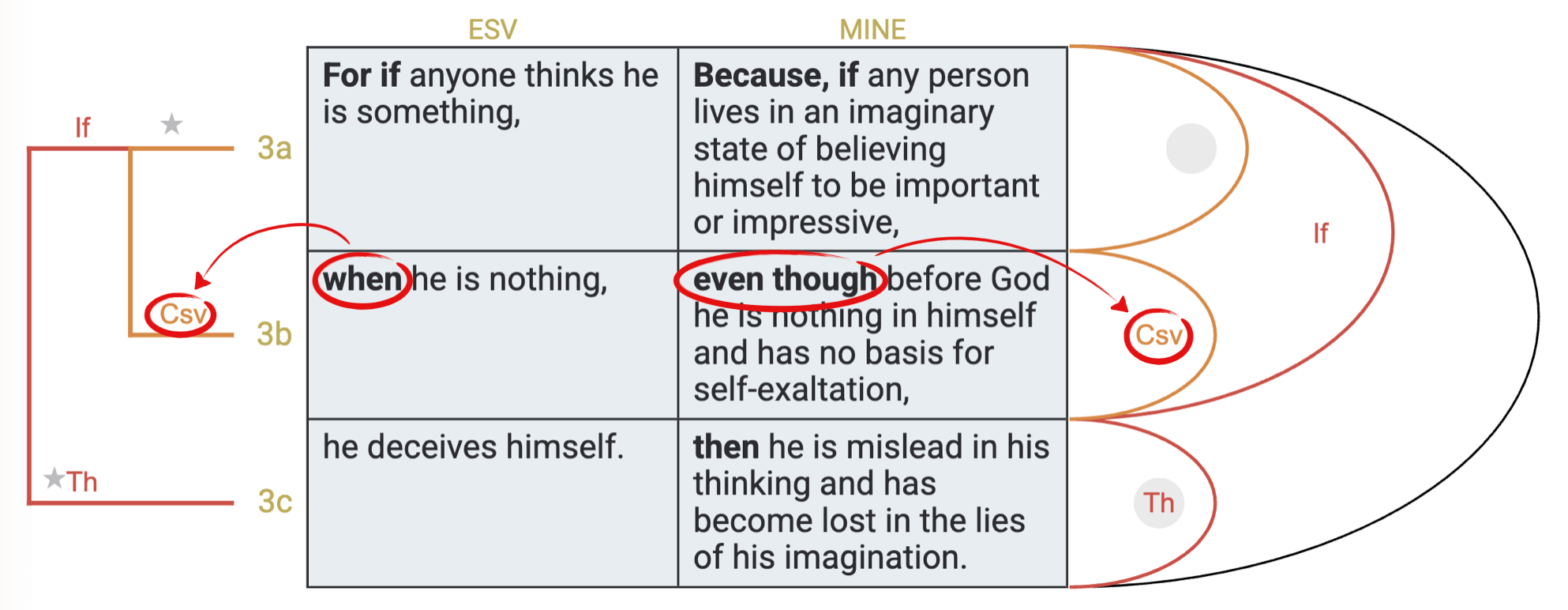
Notice that, when the testing conjunction “even though” is used, 3b clearly emerges as an objection to 3a—
"He thinks he's something!" says the author.
"Yeah, but he's nothing!" responds the objector.
"Ah, but even though he is nothing, he thinks he is something."
There is a sense of keen satisfaction when a pesky conjunction’s logic is correctly identified!
The Ubiquitous and Versatile “And”
And. It is everywhere, and it is used by everyone. And it should never be used to start a sentence (or so we learned in grammar school). And if you think about it, “and” has a wide variety of meanings. Let me illustrate.
Walk that slow and you will be late.
(Conditional: If you walk that slow, then you will be late.)
He spoke to them and called out saying, “Do not be afraid.”
(Explanation: He spoke to them, that is, he called out to them saying…)
They ate pizza and chips and salsa.
(Series: Equal parts of a list.)
They swam across the lake, and ran a 5k, and biked a 10k.
(Progression: Equal parts that develop one upon another.)
The clock struck noon and they got up to leave.
(Temporal: When the clock struck noon, they got up to leave.)
He called out, “Lazarus, come forth!” And Lazarus walked out of the tomb.
(Result: He called out… and as a result, Lazarus walked out.)
Let him call for the elders of the church and let them pray over him.
(Purpose: Let him call for the elders so that they may pray over him.)
You cannot rouse a bear from its winter sleep, and neither can you rouse a sluggard from his.
(Comparison: Like a hibernating bear… so also is a sluggard)
He hates broccoli, and he ate it all!
(Concessive: Even though he hates broccoli, he ate it anyway.)
So what’s the point? Don’t simply pass by an “and,” thinking it only means “and another thing.” Stop and consider what connection that particular “and” is making. Then paraphrase it with a clearer conjunction.