Lesson 4 | Grammatical Logic
Paraphrasing Prepositional Phrases
Prepositional phrases are not normally divided off. But as you have learned through Bracketing, there are times when they could be divided due to preference, or should be divided due to the logical weight placed upon them. Like a tiny hook upon which hangs a massive chandelier, the biblical author may choose to use a prepositional phrase as a hinge upon which to hang enormous truths.

Paraphrasing the Logic of Prepositions
Prepositions are like conjunctions in that they communicate a kind of logic. However, they are unlike conjunctions in that they do not connect one verbal idea to another. Prepositional phrases are often identified by noting a spatially oriented word followed by a noun or noun phrase. Some common prepositions are above, beside, concerning, down from, except for, in, from, like, under, over, against, through, etc.
When you see a prepositional phrase that appears important, follow these guidelines to use a paraphrase in order to test which relationship fits best.
- Divide the prepositional phrase and attempt to identify on the surface which logical relationship is the best fit.
- Restate it in your paraphrase with a clearly stated verb and an explicit conjunction.
- Read through your paraphrase to test whether that proposition follows the logic of the Bible passage.
- If not, adjust both bracket and paraphrase until it properly expresses the logic of the text.
Paraphrasing Principle
A prepositional phrase should only be divided and labeled if it can successfully be paraphrased with a clear conjunction and verb.
Example: Colossians 3:12
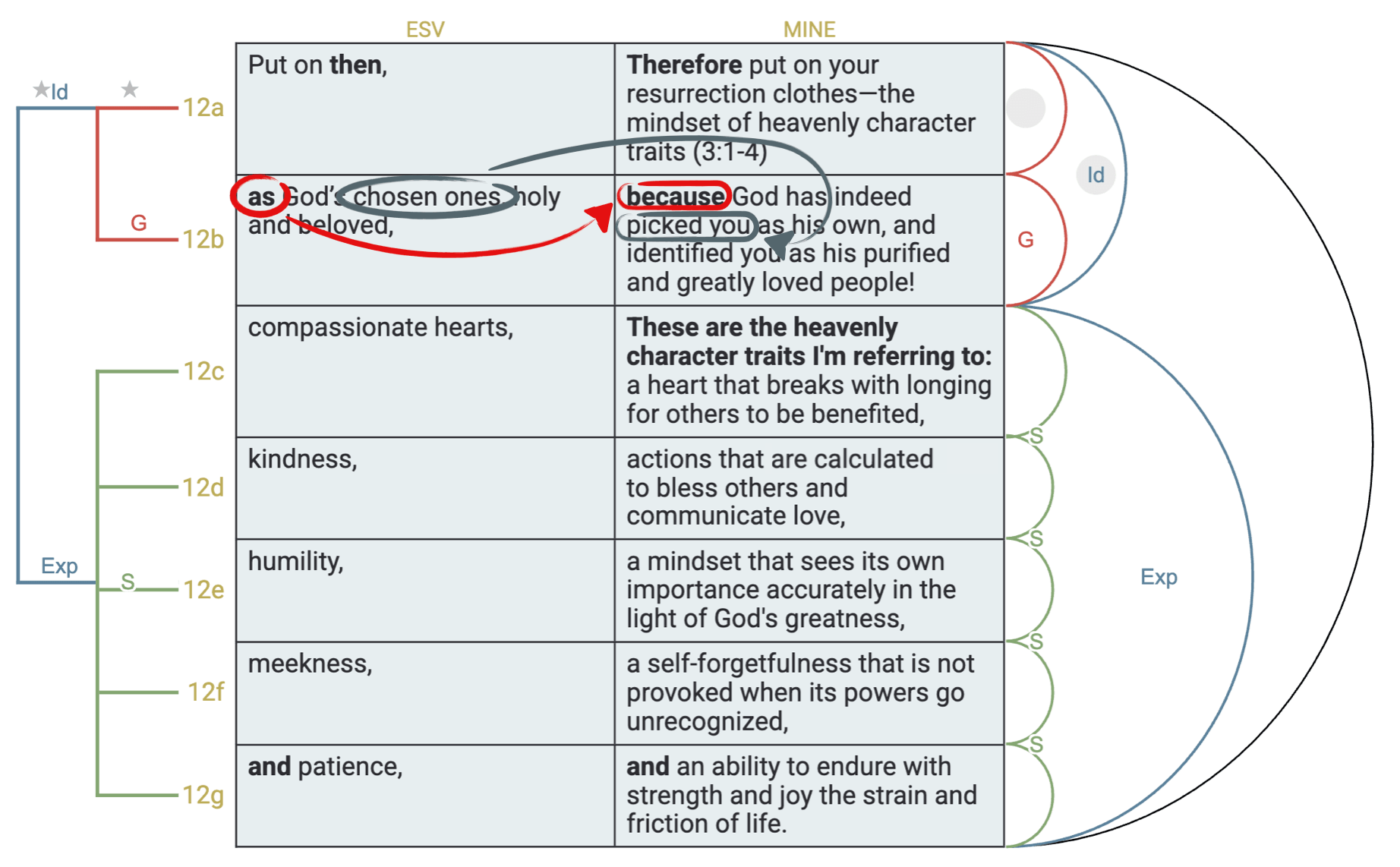
Notice that 12a begins with a command to put on certain character traits, which are later fleshed out in 12c-g. But before going into detail, Paul motivates the reader with a subtle argument by adding the prepositional phrase of 12b. It is not hard to see the verbal idea behind the adjective “chosen” in 12b, nor the logic of ground behind the preposition “as.” 12b is an important prepositional phrase because it gives a gospel-centric motivation for the command to obey. It is the indicative (statement of truth) upon which the imperative (command) stands.
What a blessing it is to obey our Lord who persuades through precious promises rather than with a harsh, demanding posture!
(Note: To see more examples of the logical relationships indicated by different prepositions, reference this page of Biblearc’s Phrasing course.)
Pesky Prepositions
In 1 Peter 4:6, we find a great example of two parallel prepositional phrases. I have used the King James Version below because it presents them most clearly as they appear in the original language, with all their parallelism.
A careful consideration of these two phrases is necessary. Who are the “dead?” Why is the gospel preached “so that” they might be judged? What is the logic of the “but” in the midst of the two prepositional phrases?
Consider how other translations have attempted to deal with some of these questions. This is certainly a case in which these prepositional phrases need to be divided.
Now it's your turn. How would you paraphrase 1 Peter 4:6?Optional
Log in / create an account to enroll or continue where you left off.
Now consider John Piper’s take on the same passage: